Doron Segal Founder · CTO · YC W21 Book a call
TALK

Marketing by an Engineer

32 slides 12 campaigns 4 engines 1996 – 2026 Download the deck (PDF)
Use ← → to move · G for the grid
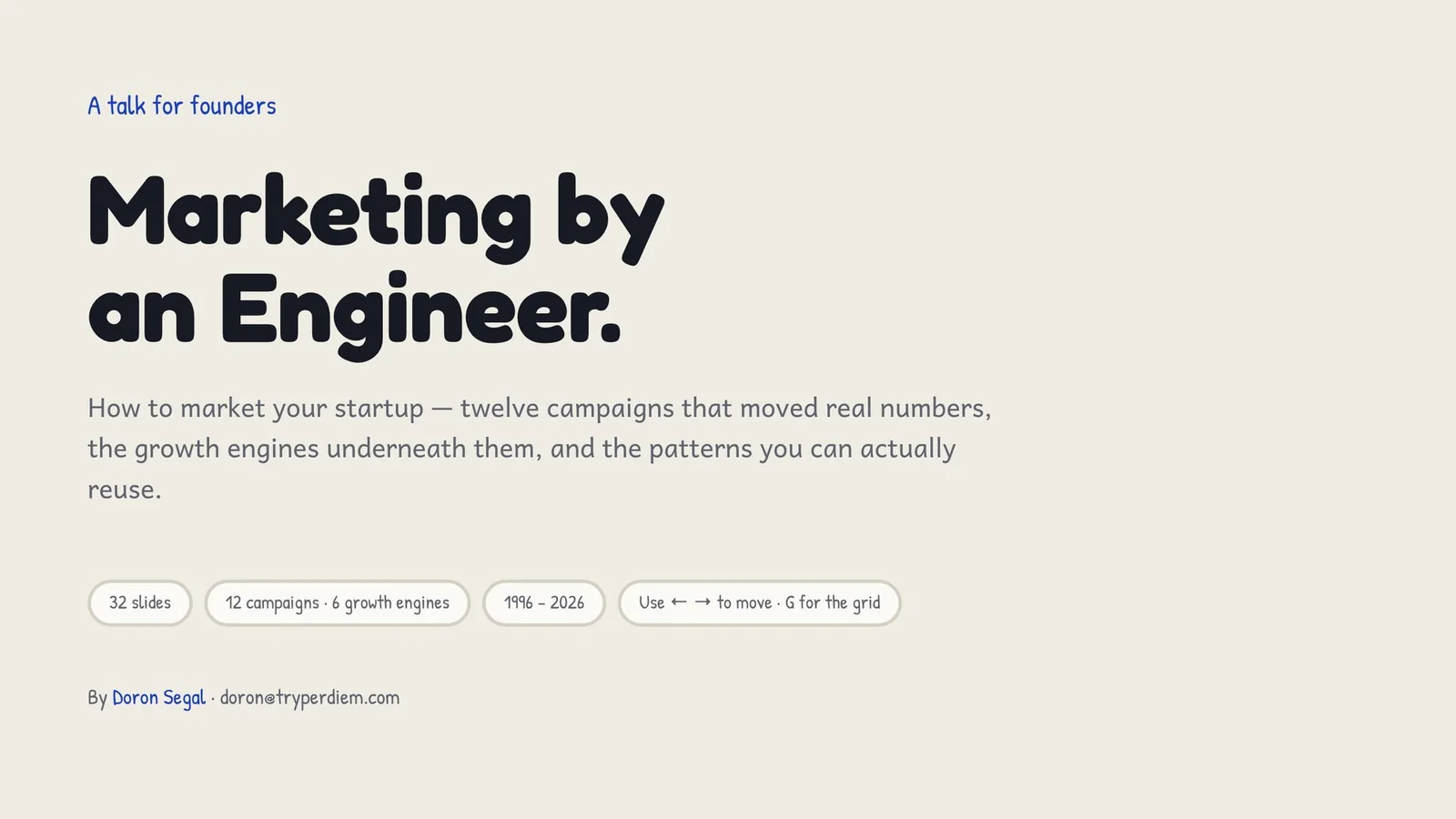
  1. Title slide: a talk for founders on twelve campaigns that moved real numbers, the growth engines underneath them, and the patterns you can reuse. 1 Marketing by an Engineer
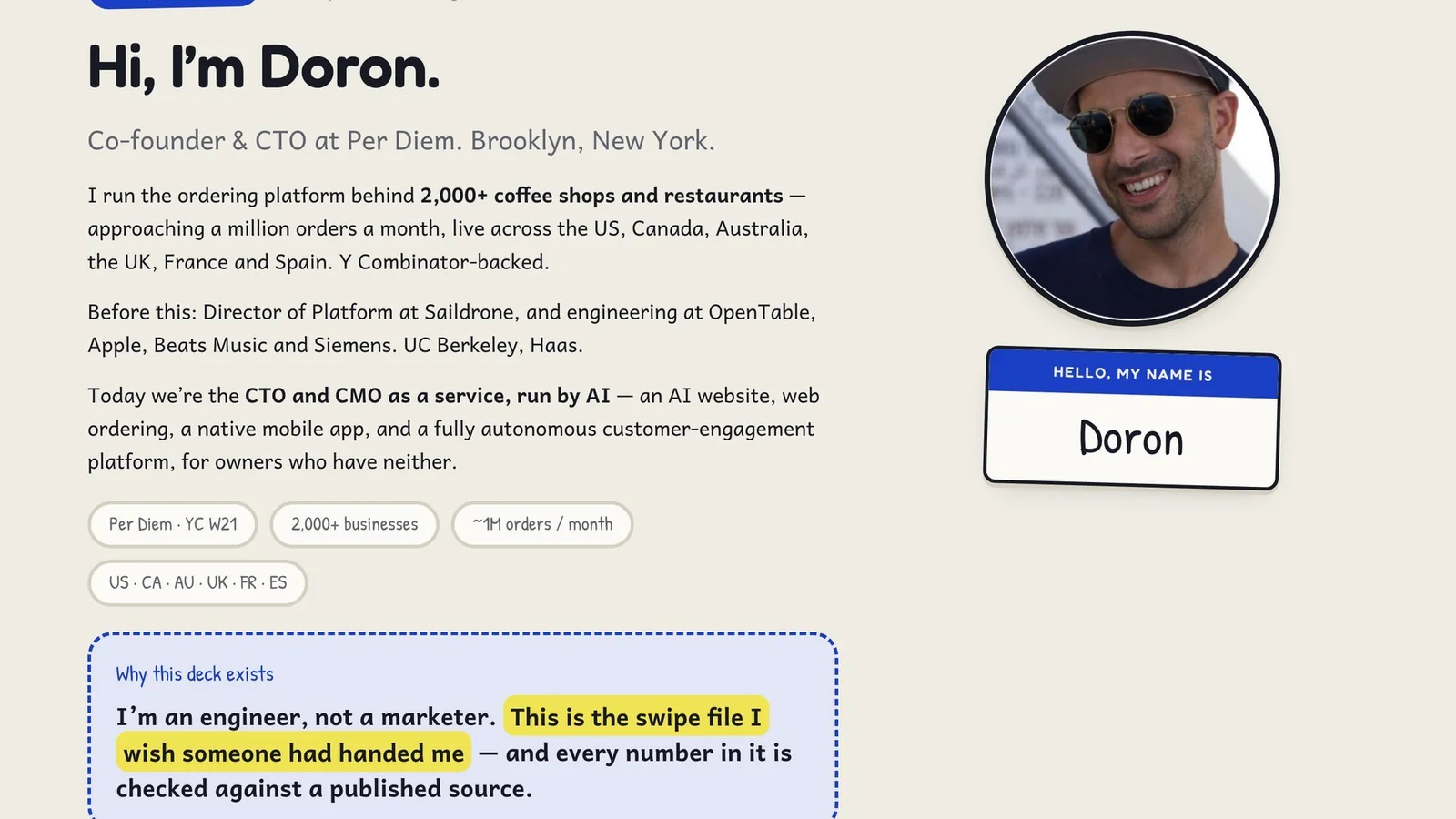
  2. Introduction: co-founder and CTO at Per Diem in Brooklyn, running the ordering platform behind 2,000+ coffee shops and restaurants, approaching a million orders a month. 2 Hi, I'm Doron
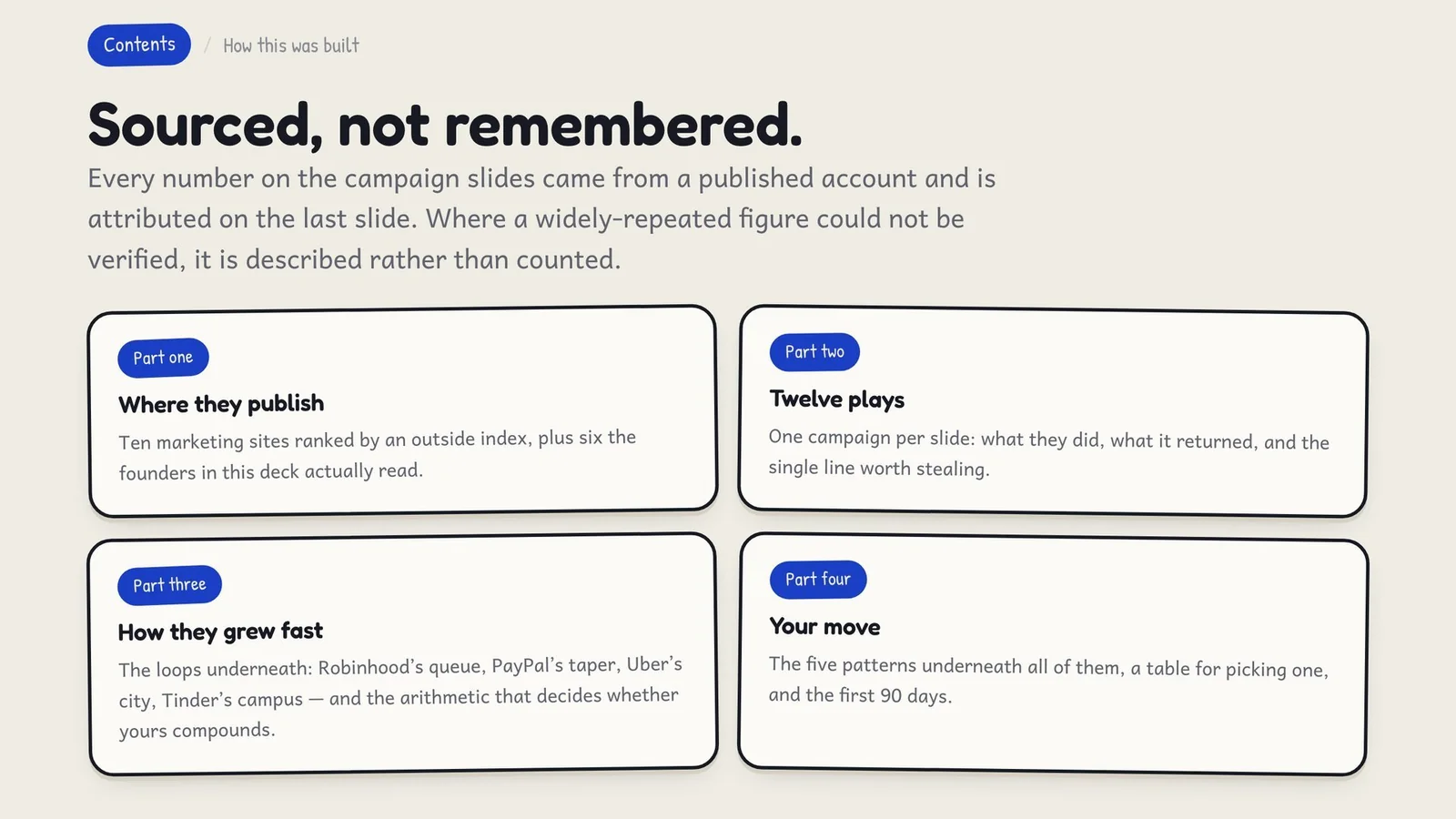
  3. Contents: every number on the campaign slides comes from a published account, attributed on the last slide. Four parts — where they publish, twelve plays, how they grew fast, and your move. 3 Sourced, not remembered
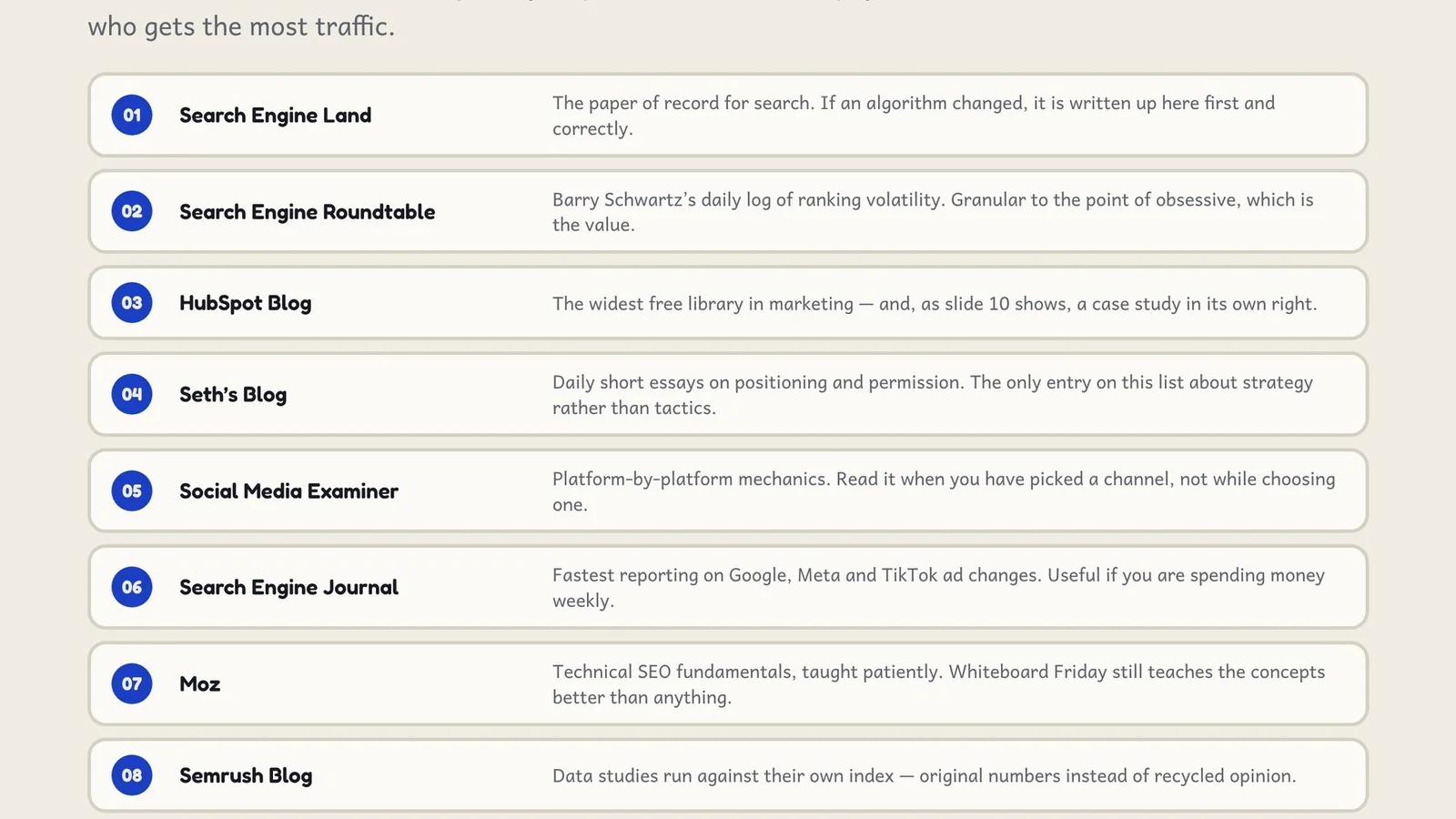
  4. Ten marketing sites ranked by an outside index: Search Engine Land, Search Engine Roundtable, HubSpot Blog, Seth's Blog, Social Media Examiner, Search Engine Journal, Moz and the Semrush Blog. 4 Where they publish
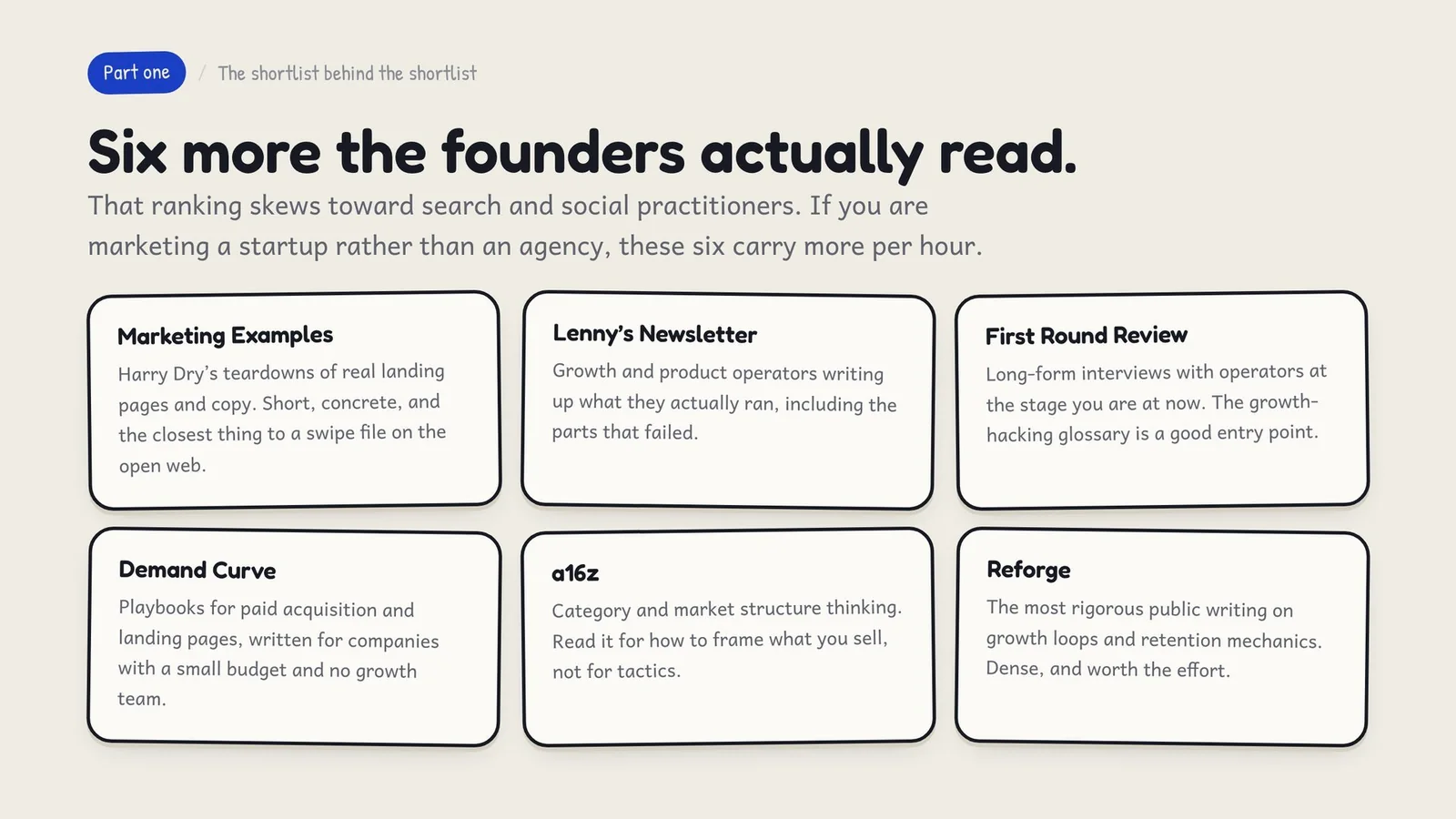
  5. Marketing Examples, Lenny's Newsletter, First Round Review, Demand Curve, a16z and Reforge — the sites that carry more per hour if you are marketing a startup rather than an agency. 5 Six more the founders actually read
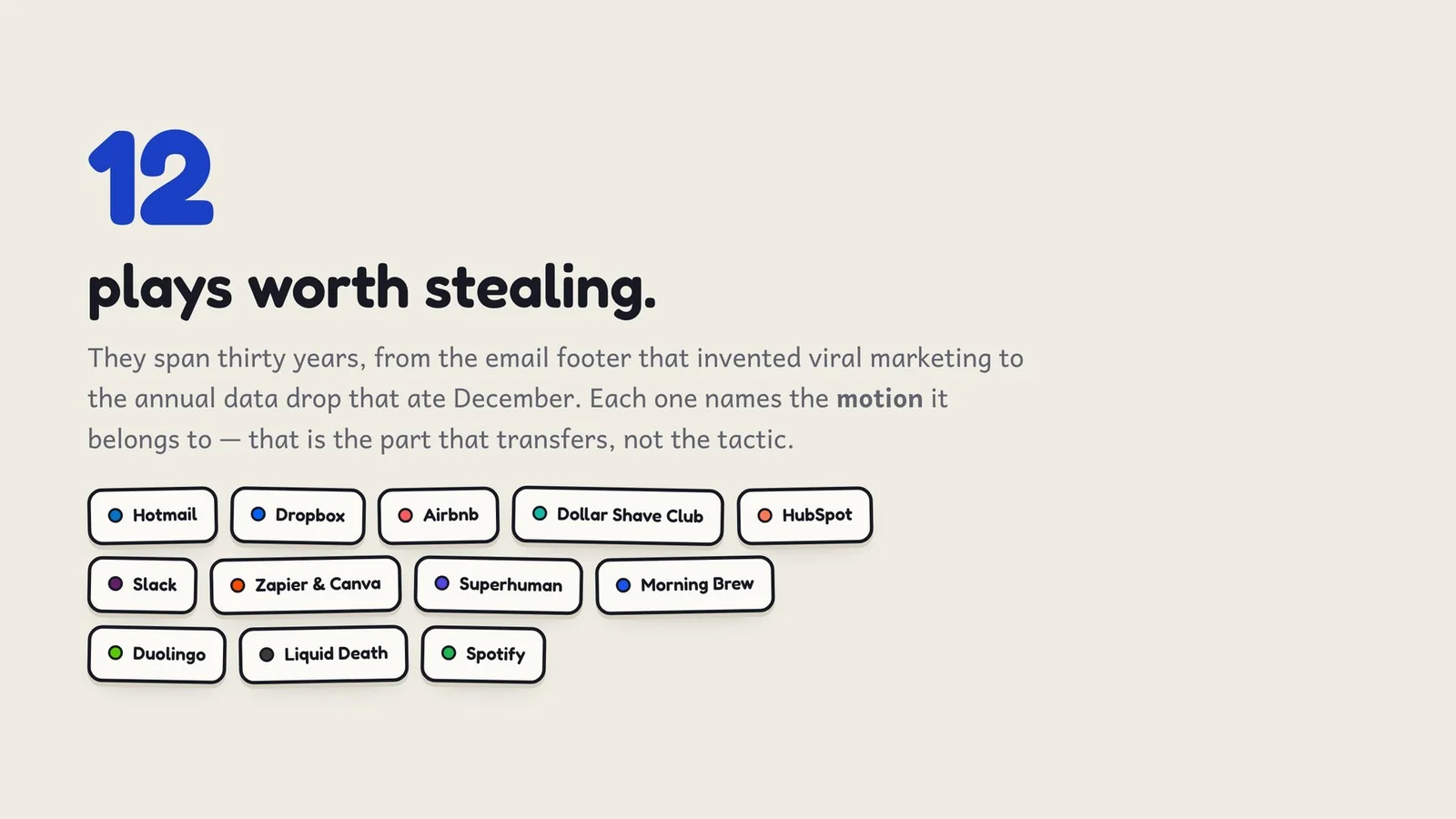
  6. The twelve campaigns, spanning thirty years: Hotmail, Dropbox, Airbnb, Dollar Shave Club, HubSpot, Slack, Zapier and Canva, Superhuman, Morning Brew, Duolingo, Liquid Death and Spotify. 6 12 plays worth stealing
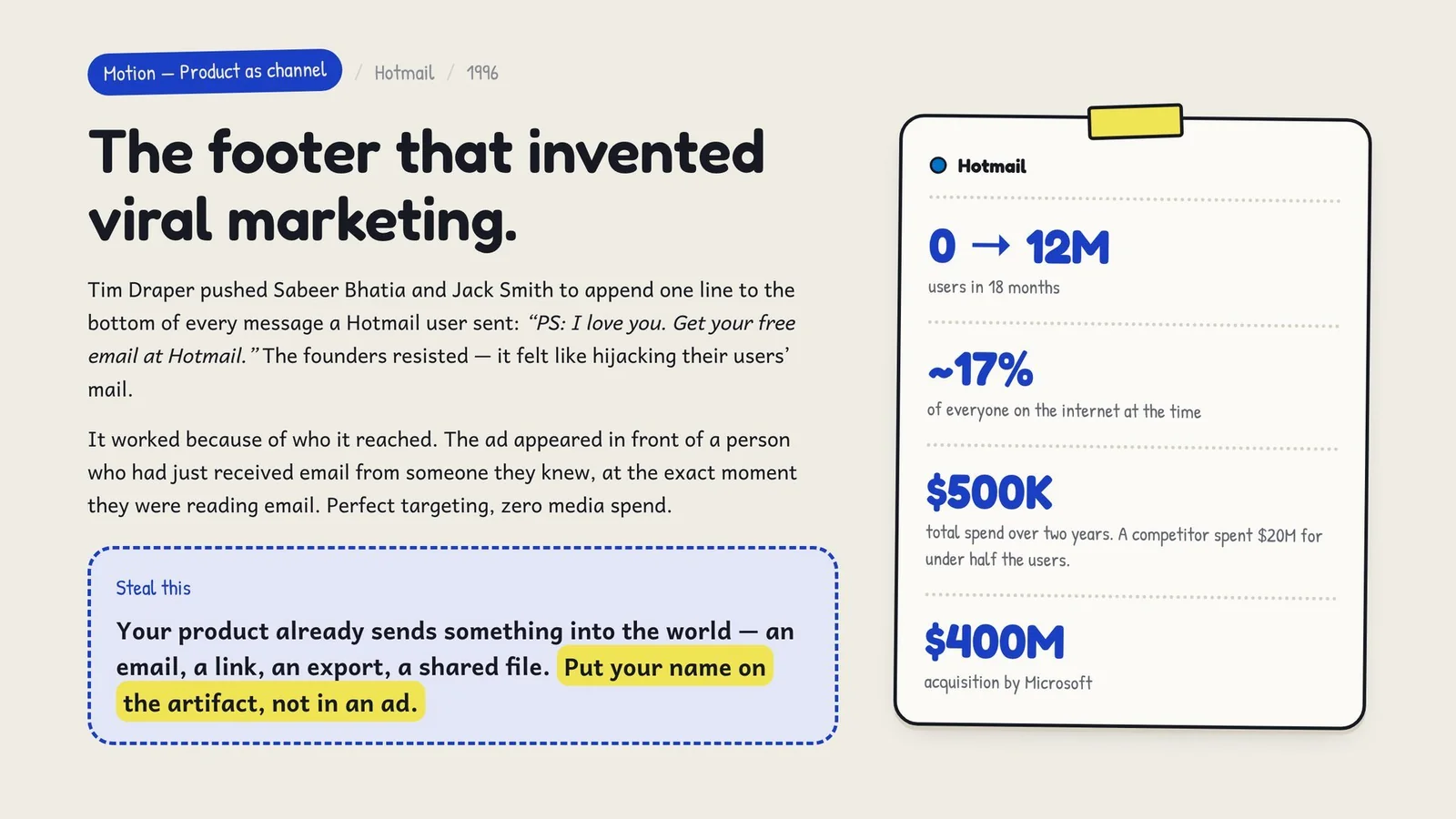
  7. One line appended to every message — "PS: I love you. Get your free email at Hotmail." — took Hotmail from 0 to 12M users in 18 months on $500K of spend. Steal this: put your name on the artifact, not in an ad. 7 Hotmail: the footer that invented viral marketing
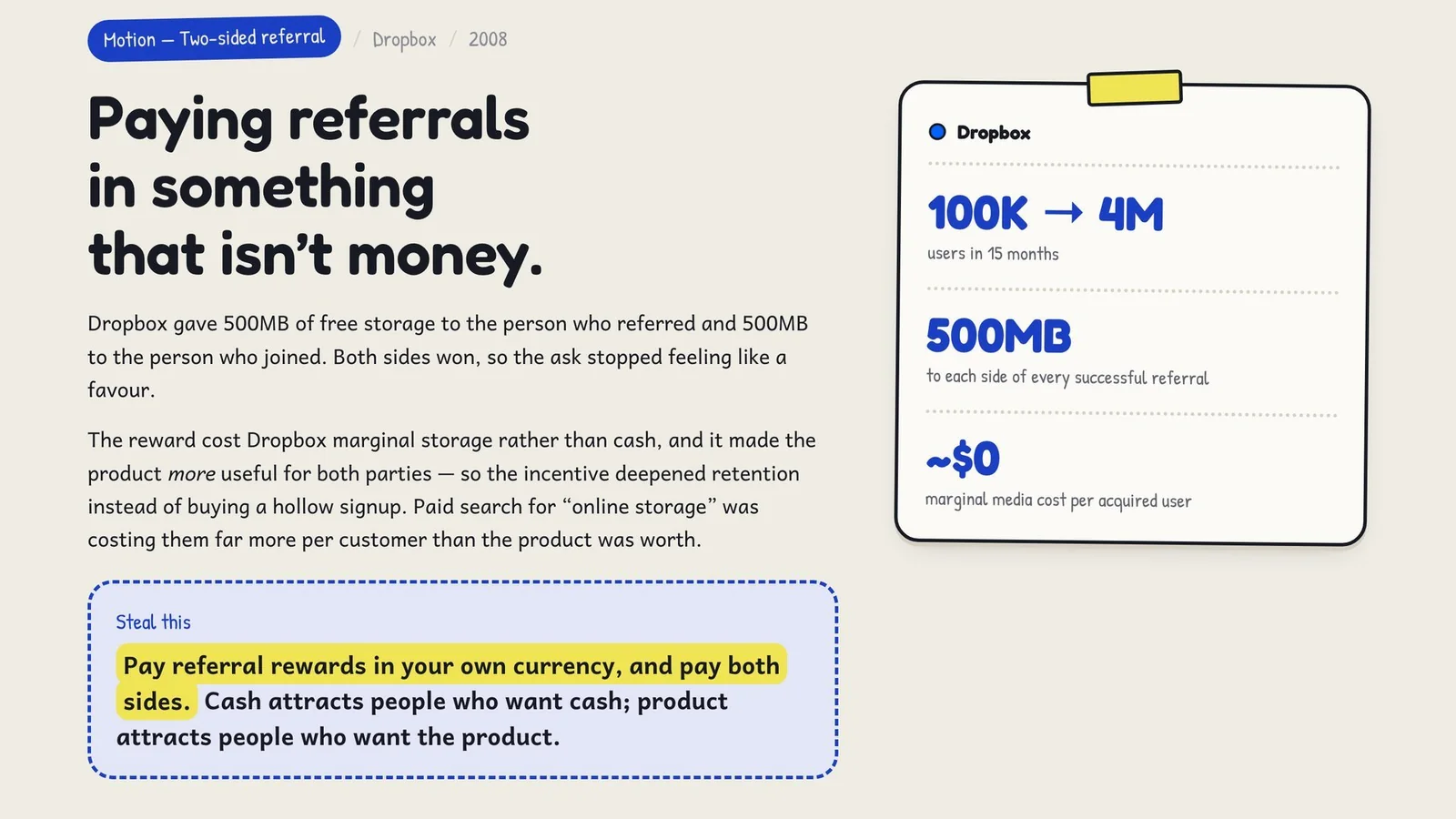
  8. 500MB of free storage to each side of a referral took Dropbox from 100K to 4M users in 15 months at roughly zero marginal media cost. Steal this: pay referral rewards in your own currency, and pay both sides. 8 Dropbox: paying referrals in something that isn't money
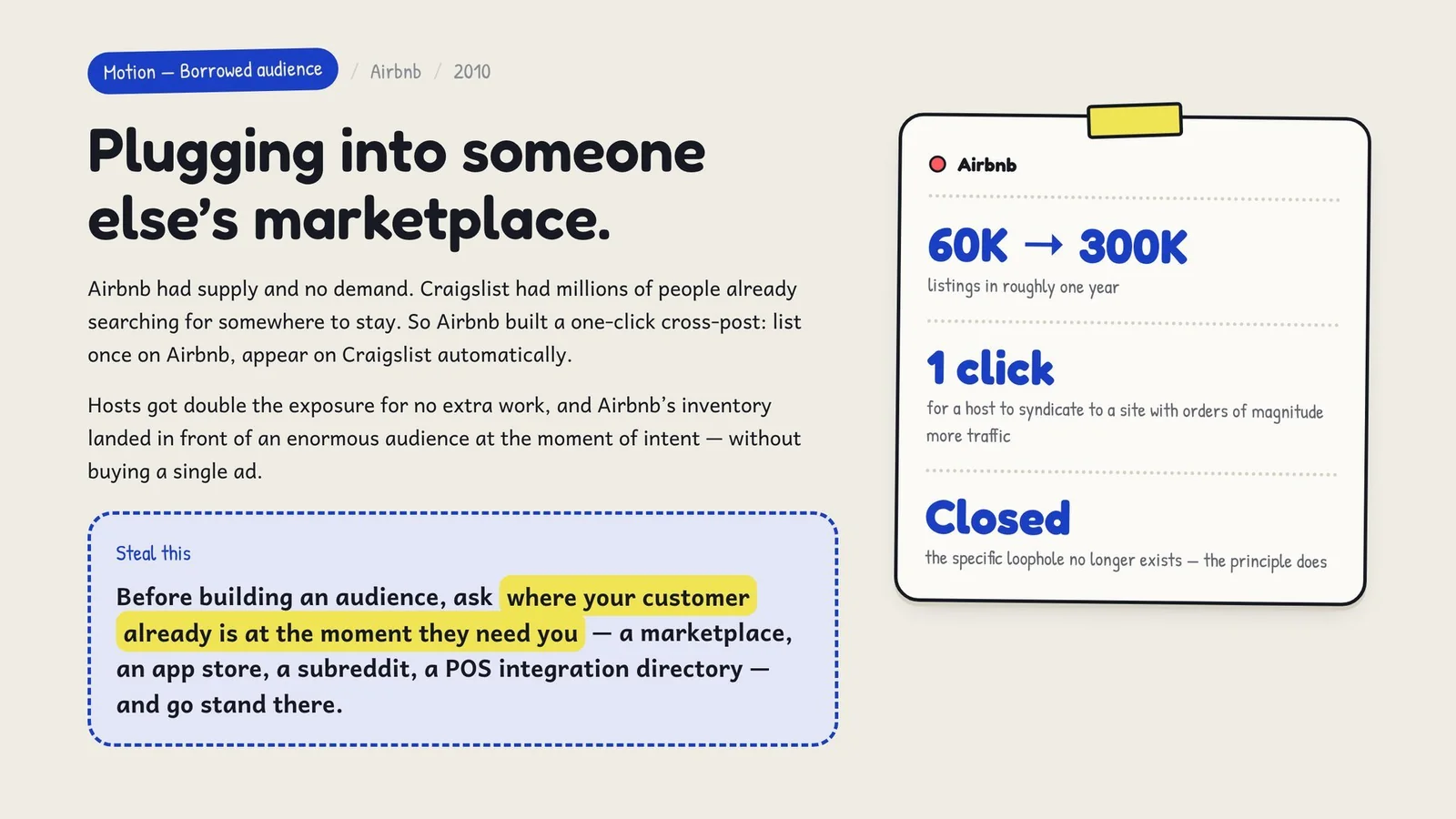
  9. A one-click cross-post to Craigslist put Airbnb's listings in front of an audience it never had to build, growing from 60K to 300K listings in about a year. Steal this: ask where your customer already is at the moment they need you. 9 Airbnb: plugging into someone else's marketplace
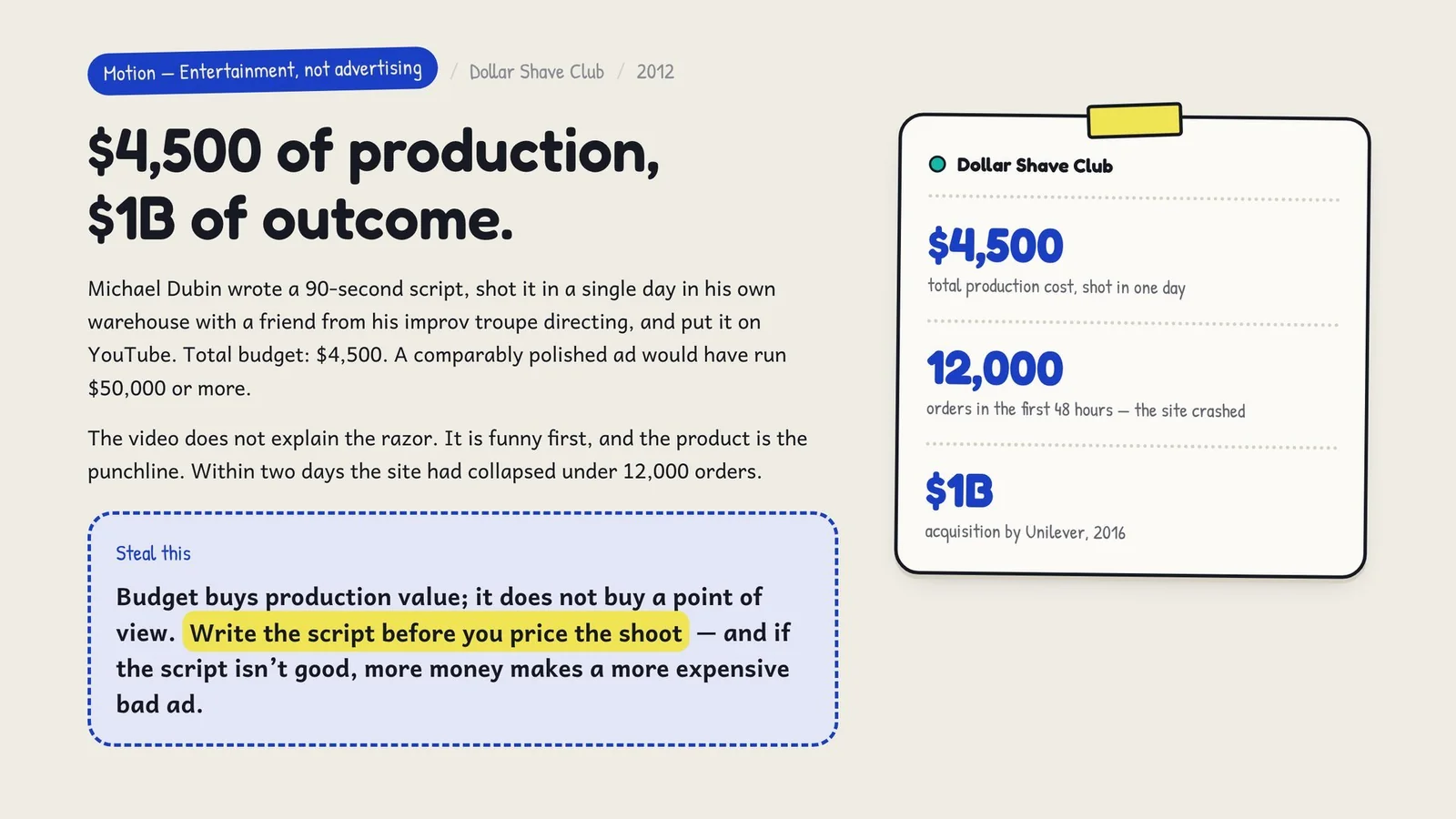
  10. A 90-second script shot in one day produced 12,000 orders in 48 hours and a $1B acquisition. Steal this: budget buys production value, not a point of view — write the script before you price the shoot. 10 Dollar Shave Club: $4,500 of production, $1B of outcome
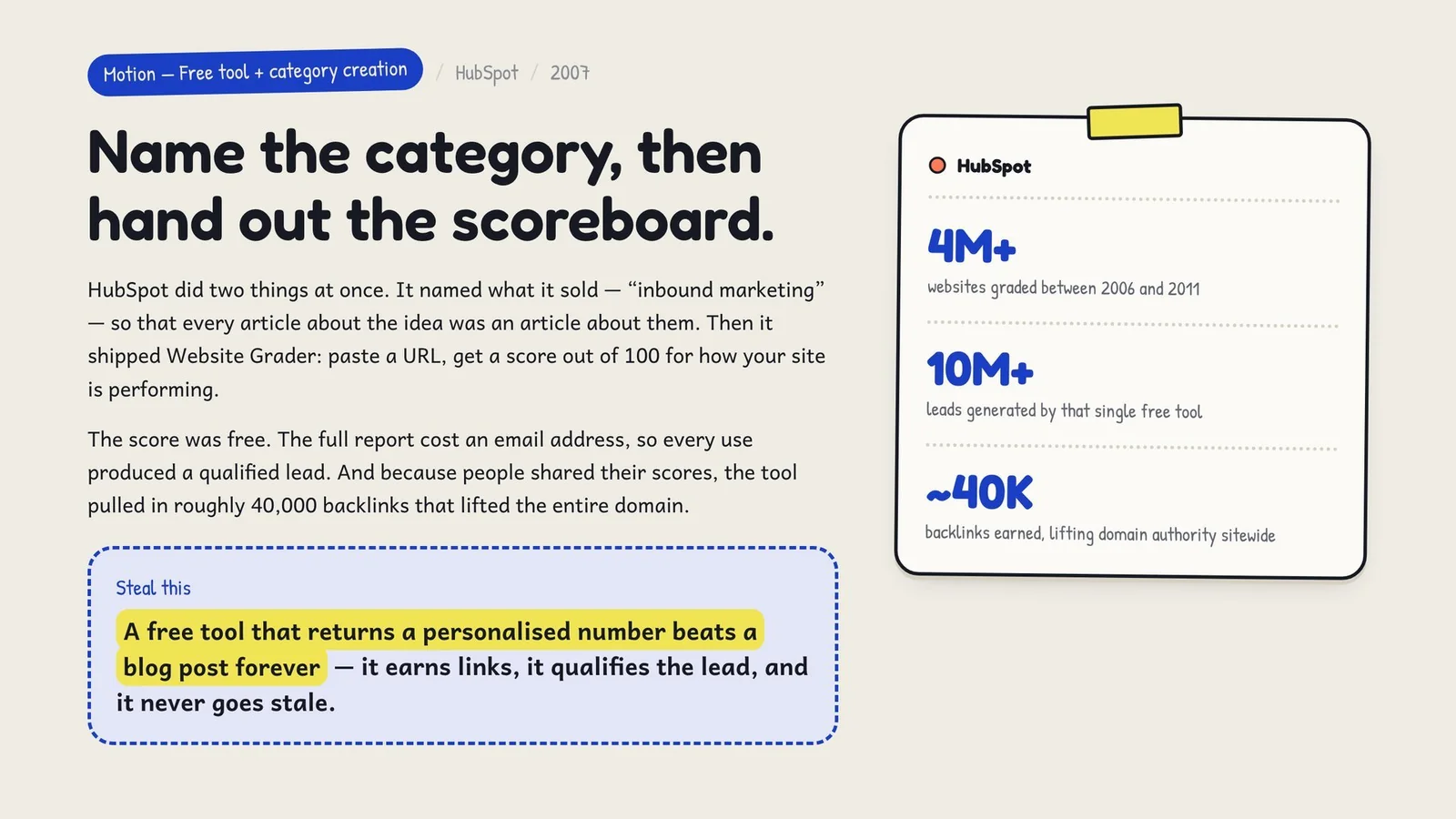
  11. Naming "inbound marketing" and shipping the free Website Grader produced 4M+ graded sites, 10M+ leads and roughly 40,000 backlinks. Steal this: a free tool that returns a personalised number beats a blog post forever. 11 HubSpot: name the category, then hand out the scoreboard
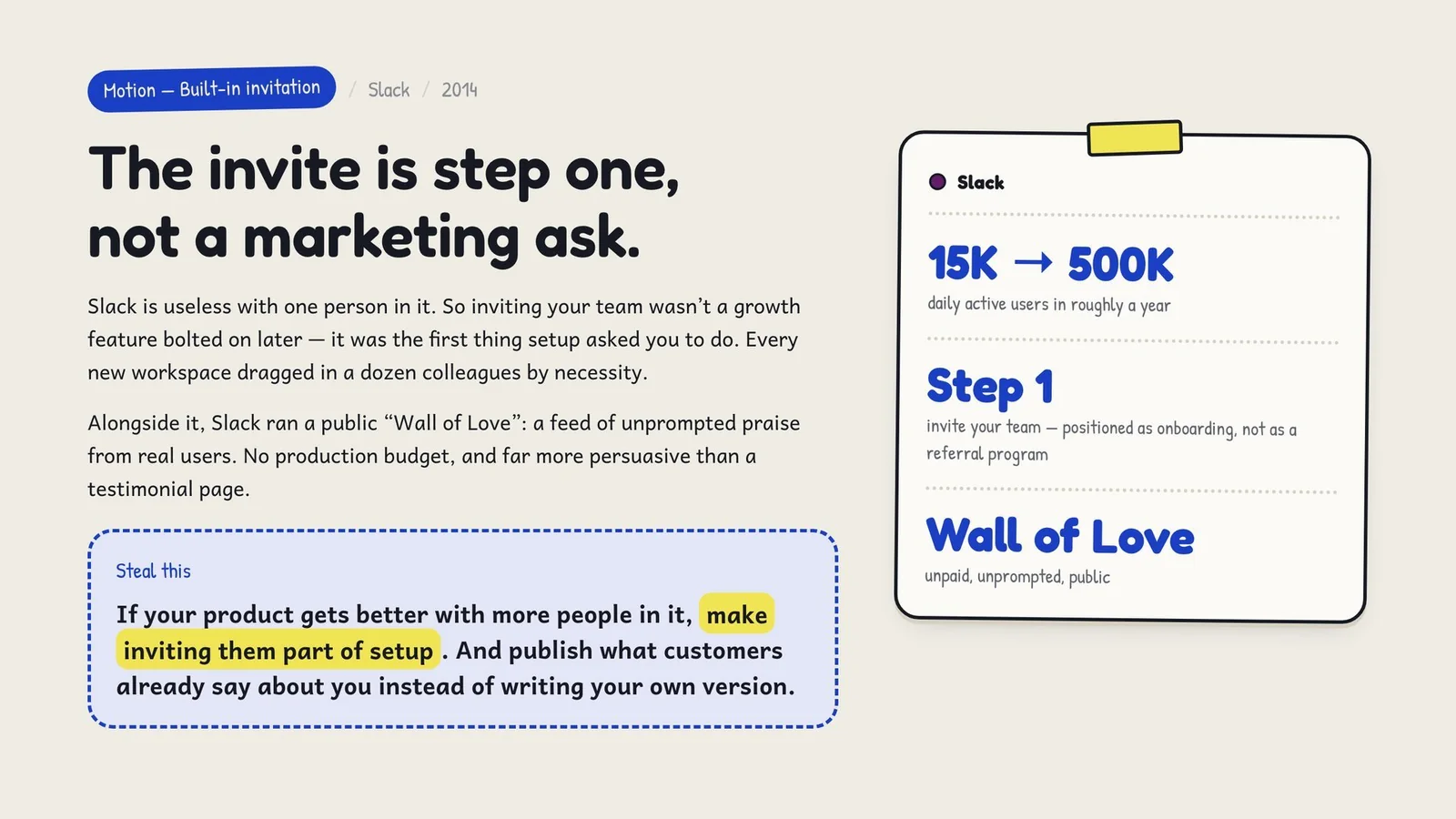
  12. Inviting your team was the first thing setup asked you to do, taking Slack from 15K to 500K daily active users in about a year, alongside a public Wall of Love. Steal this: if your product gets better with more people in it, make inviting them part of setup. 12 Slack: the invite is step one, not a marketing ask
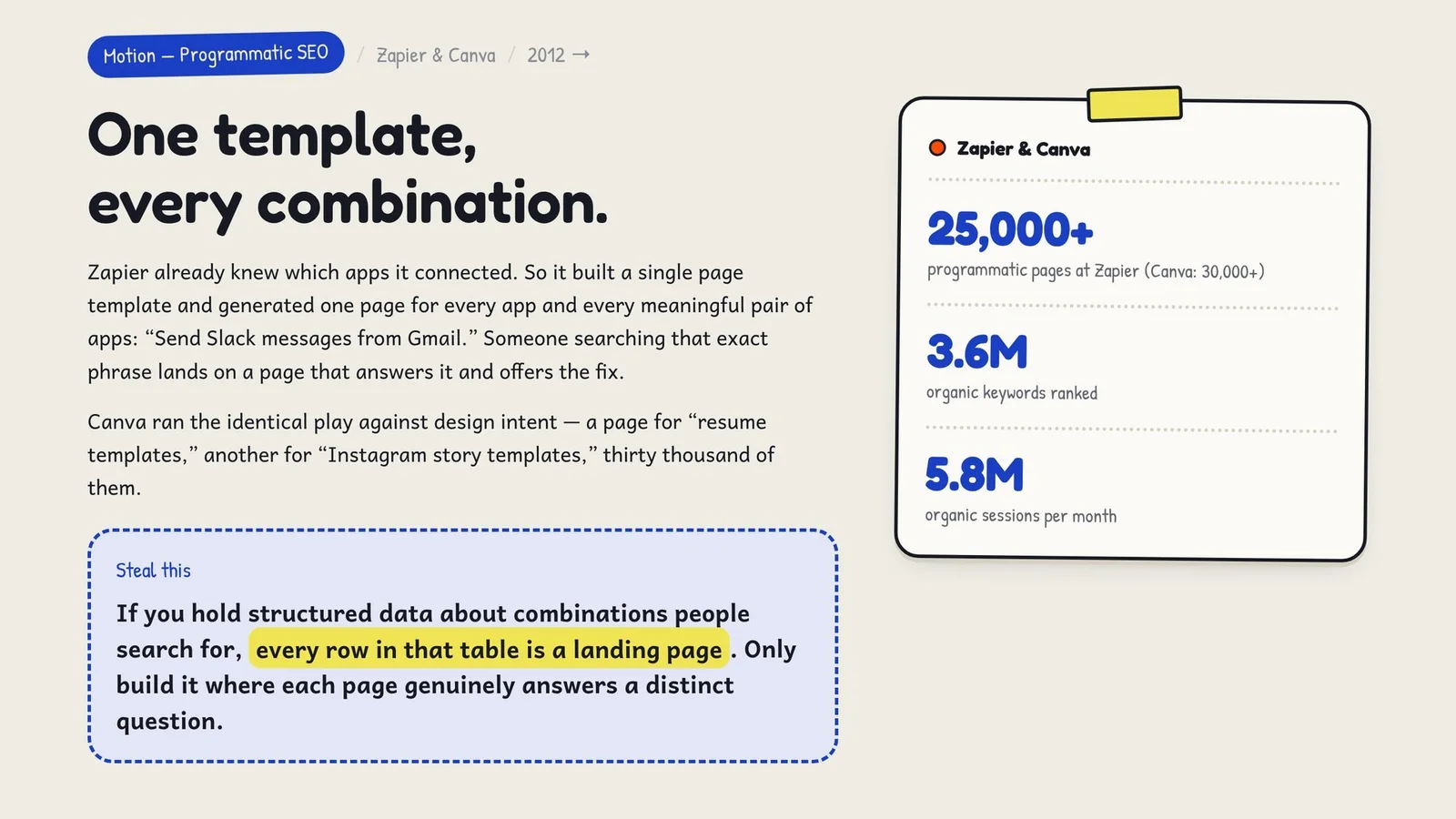
  13. One page template generated 25,000+ programmatic pages at Zapier and 30,000+ at Canva, ranking 3.6M organic keywords and 5.8M sessions a month. Steal this: if you hold structured data about combinations people search for, every row in that table is a landing page. 13 Zapier and Canva: one template, every combination
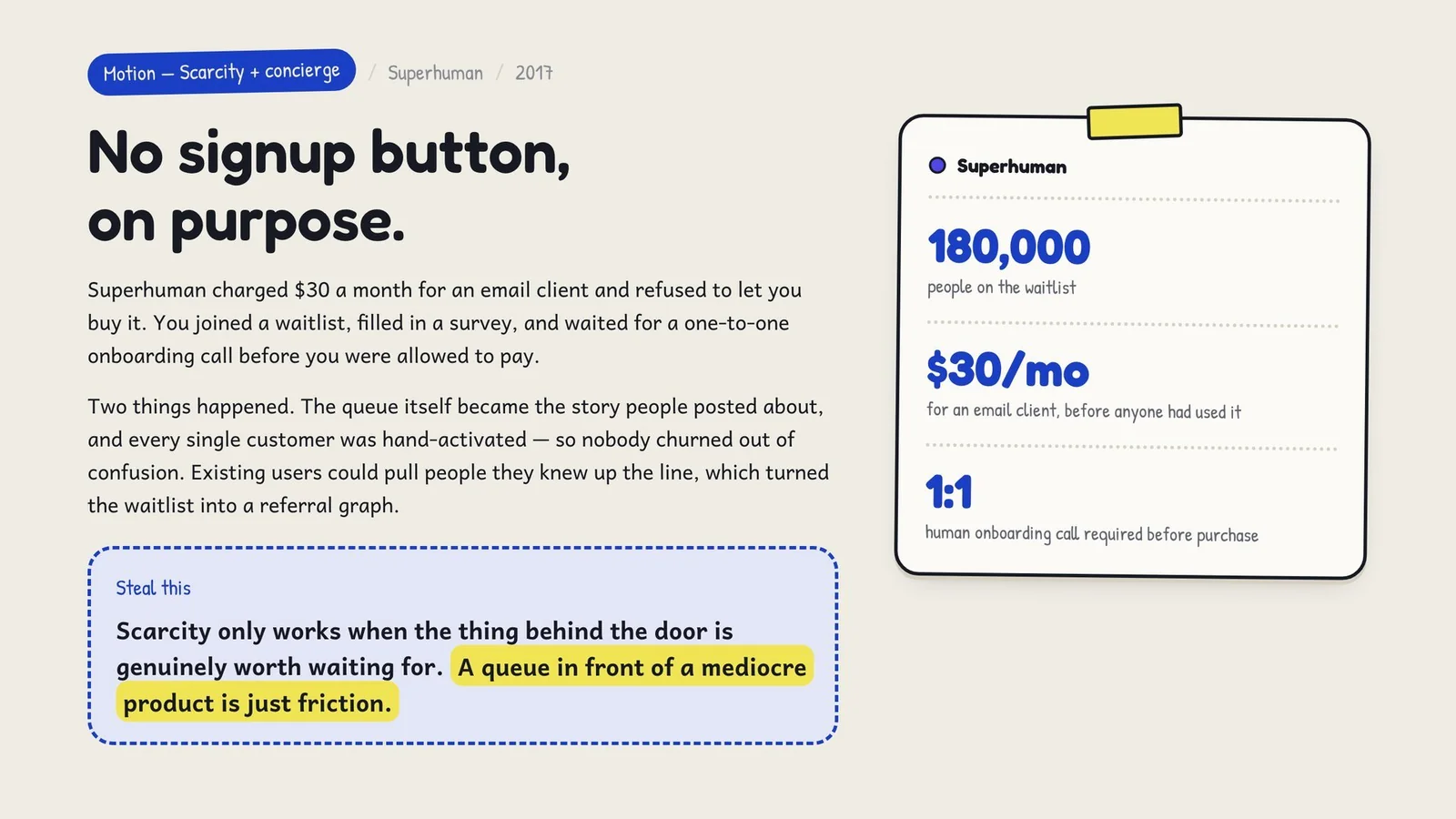
  14. A $30/month email client with a waitlist of 180,000 and a mandatory one-to-one onboarding call before you could pay. Steal this: scarcity only works when the thing behind the door is genuinely worth waiting for. 14 Superhuman: no signup button, on purpose
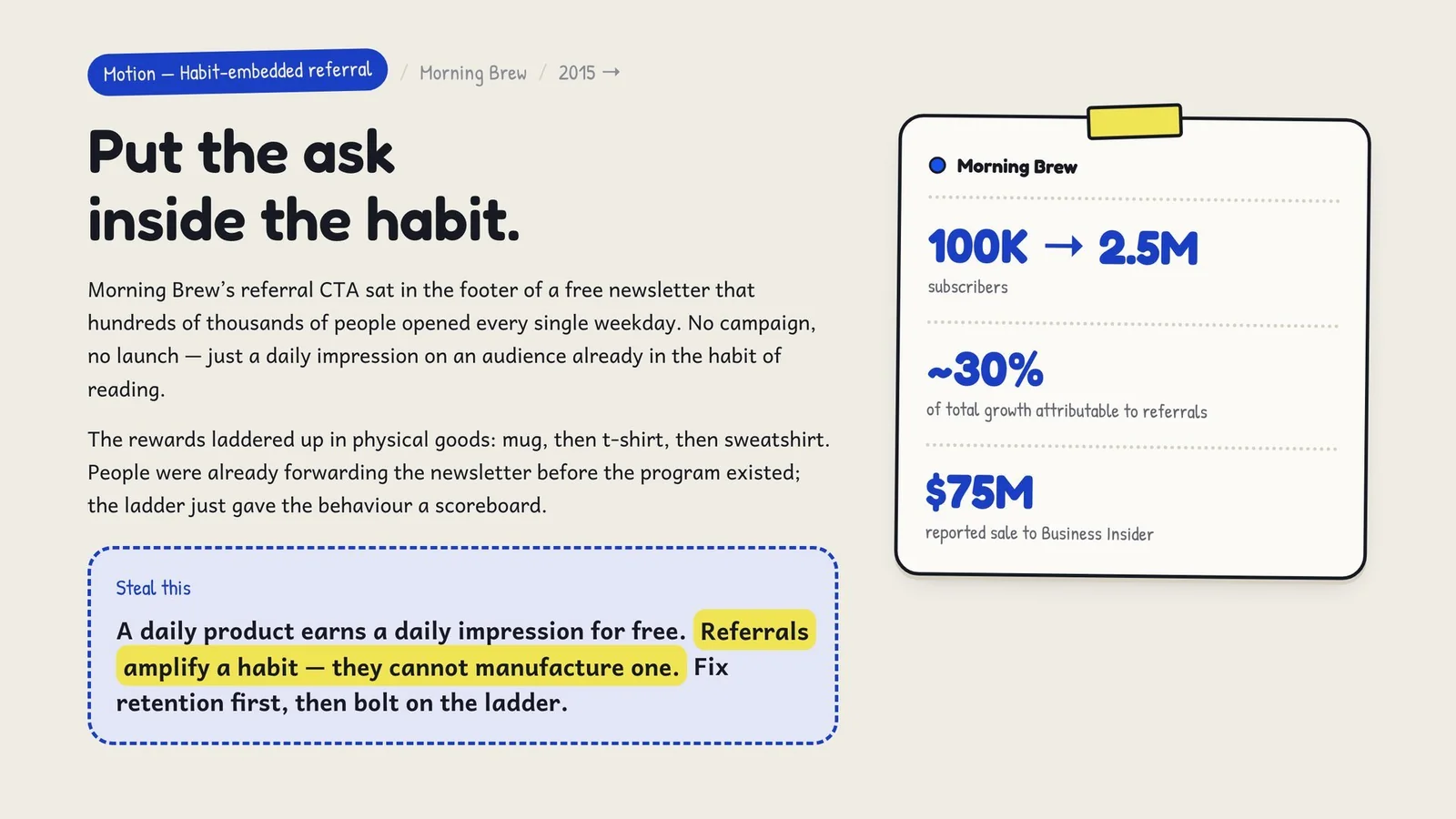
  15. A referral CTA in the footer of a free daily newsletter took Morning Brew from 100K to 2.5M subscribers, with about 30% of growth attributable to referrals and a $75M sale. Steal this: referrals amplify a habit, they cannot manufacture one. 15 Morning Brew: put the ask inside the habit
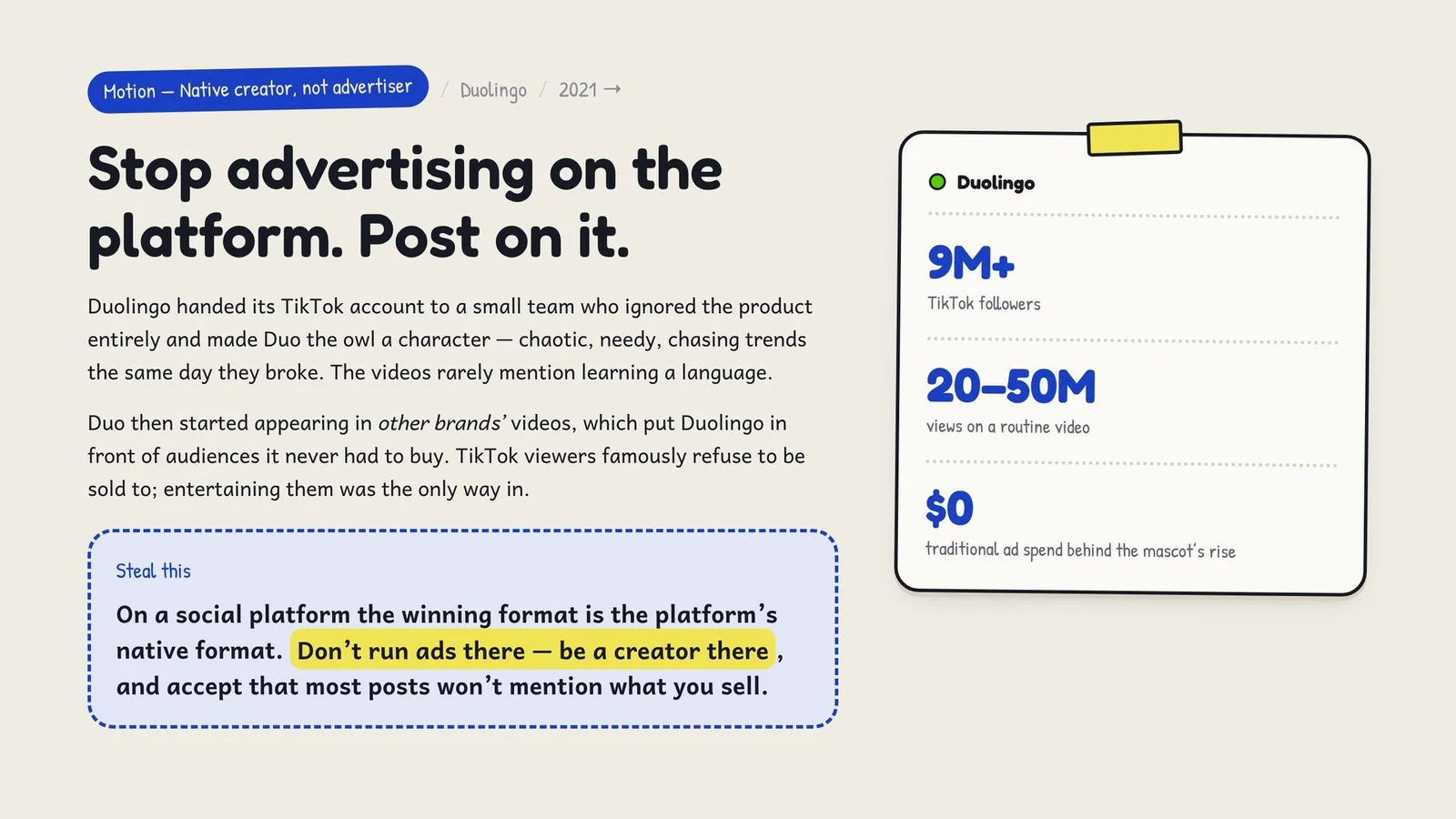
  16. Handing TikTok to a small team that made Duo the owl a character produced 9M+ followers and 20–50M views on a routine video, on $0 of traditional ad spend. Steal this: on a social platform, be a creator, not an advertiser. 16 Duolingo: stop advertising on the platform, post on it
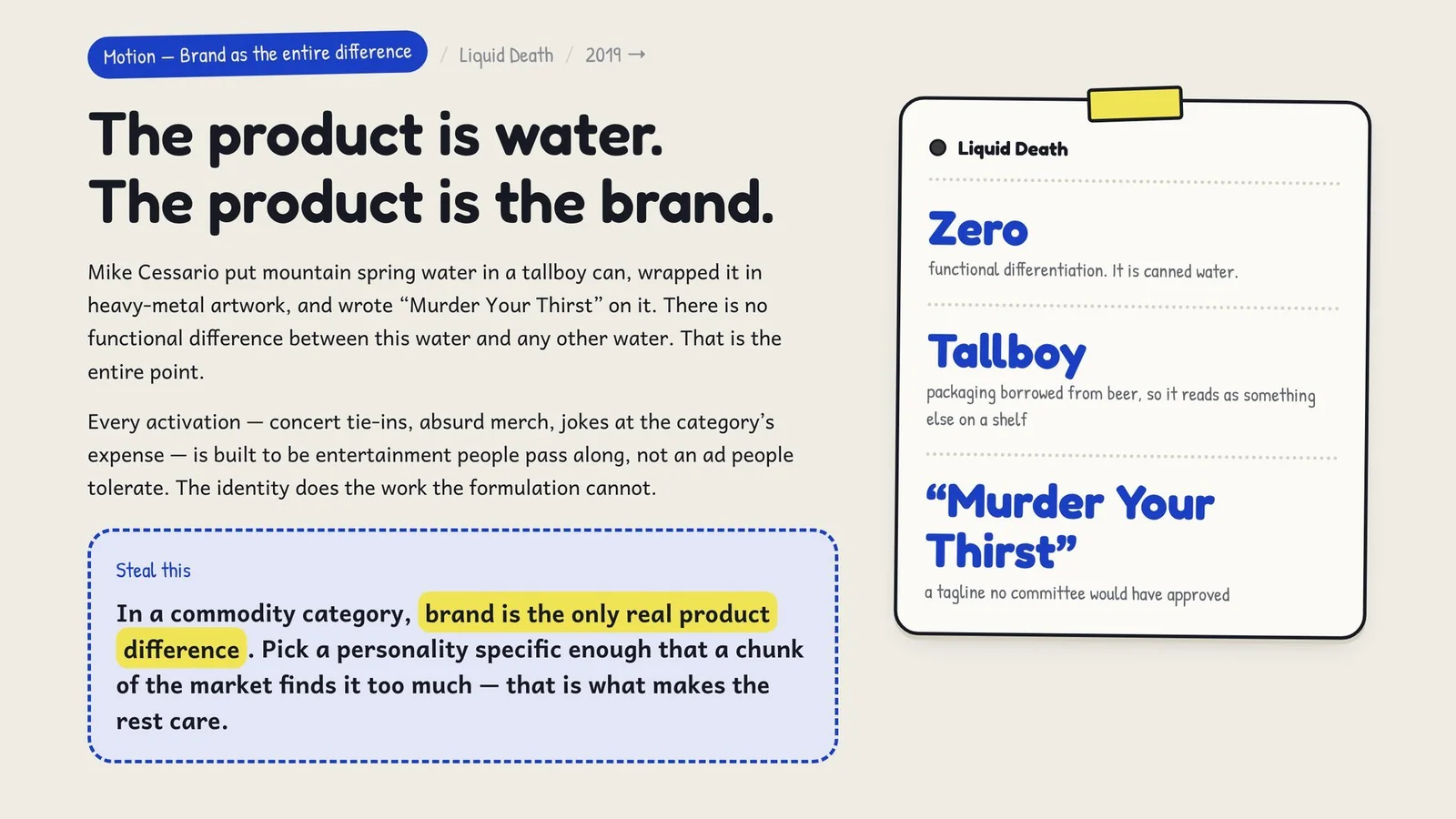
  17. Mountain spring water in a tallboy can with heavy-metal artwork and "Murder Your Thirst" on it — zero functional differentiation, entirely brand. Steal this: in a commodity category, brand is the only real product difference. 17 Liquid Death: the product is water, the product is the brand
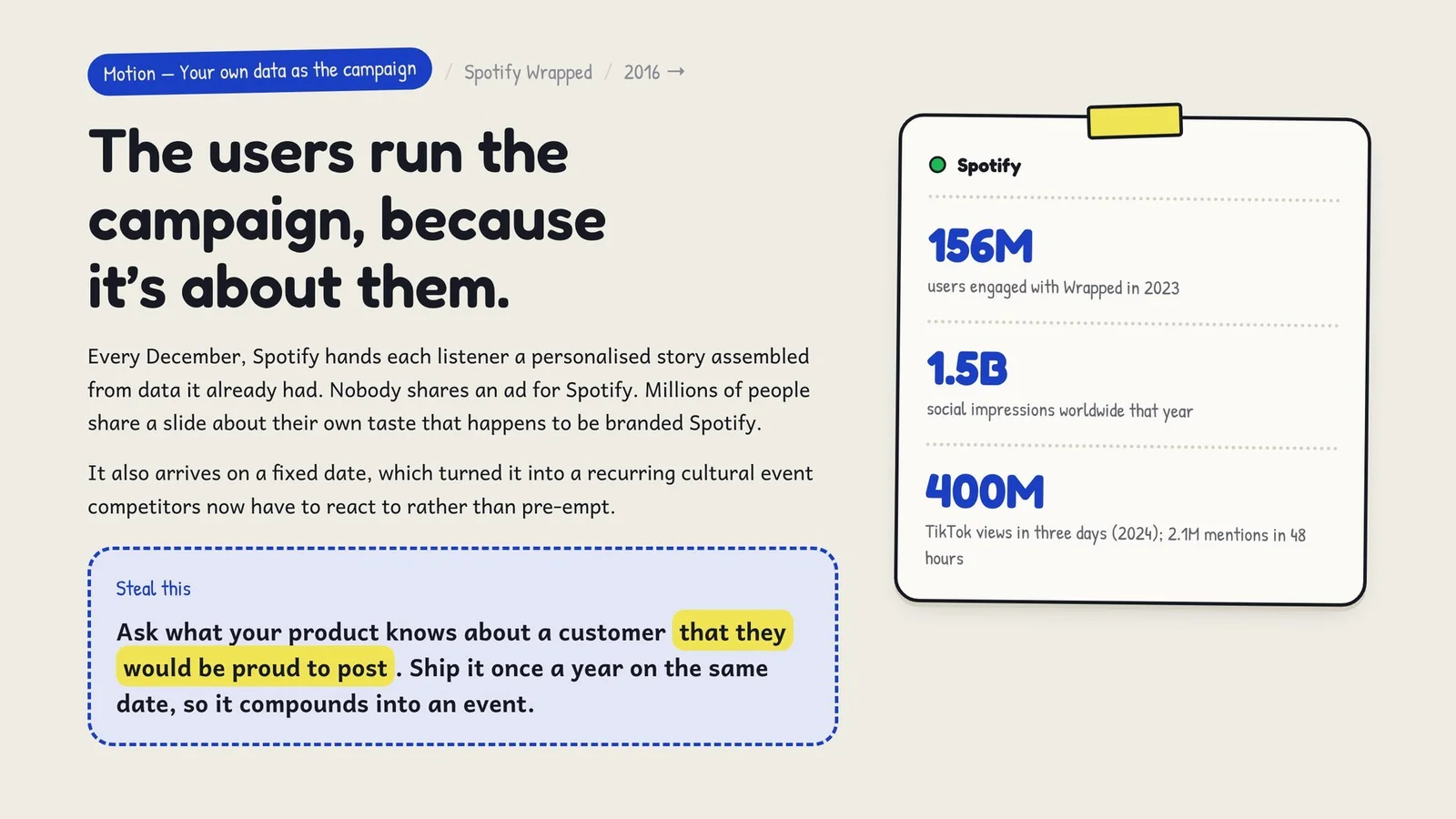
  18. A personalised annual story assembled from data Spotify already had: 156M users engaged in 2023, 1.5B social impressions and 400M TikTok views in three days. Steal this: ask what your product knows about a customer that they would be proud to post. 18 Spotify Wrapped: the users run the campaign, because it's about them
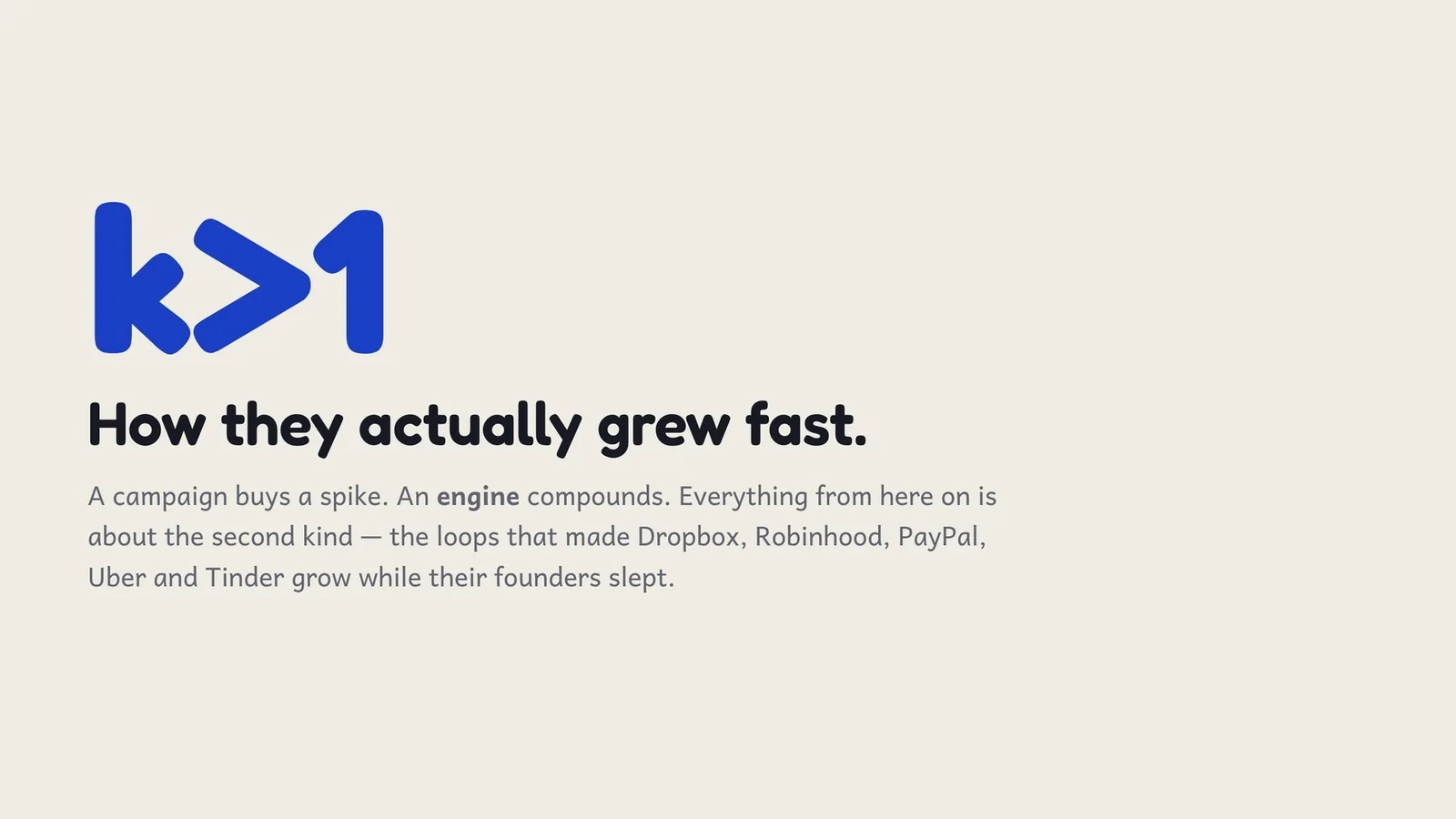
  19. Part three: a campaign buys a spike, an engine compounds. The loops that made Dropbox, Robinhood, PayPal, Uber and Tinder grow while their founders slept. 19 k > 1: how they actually grew fast
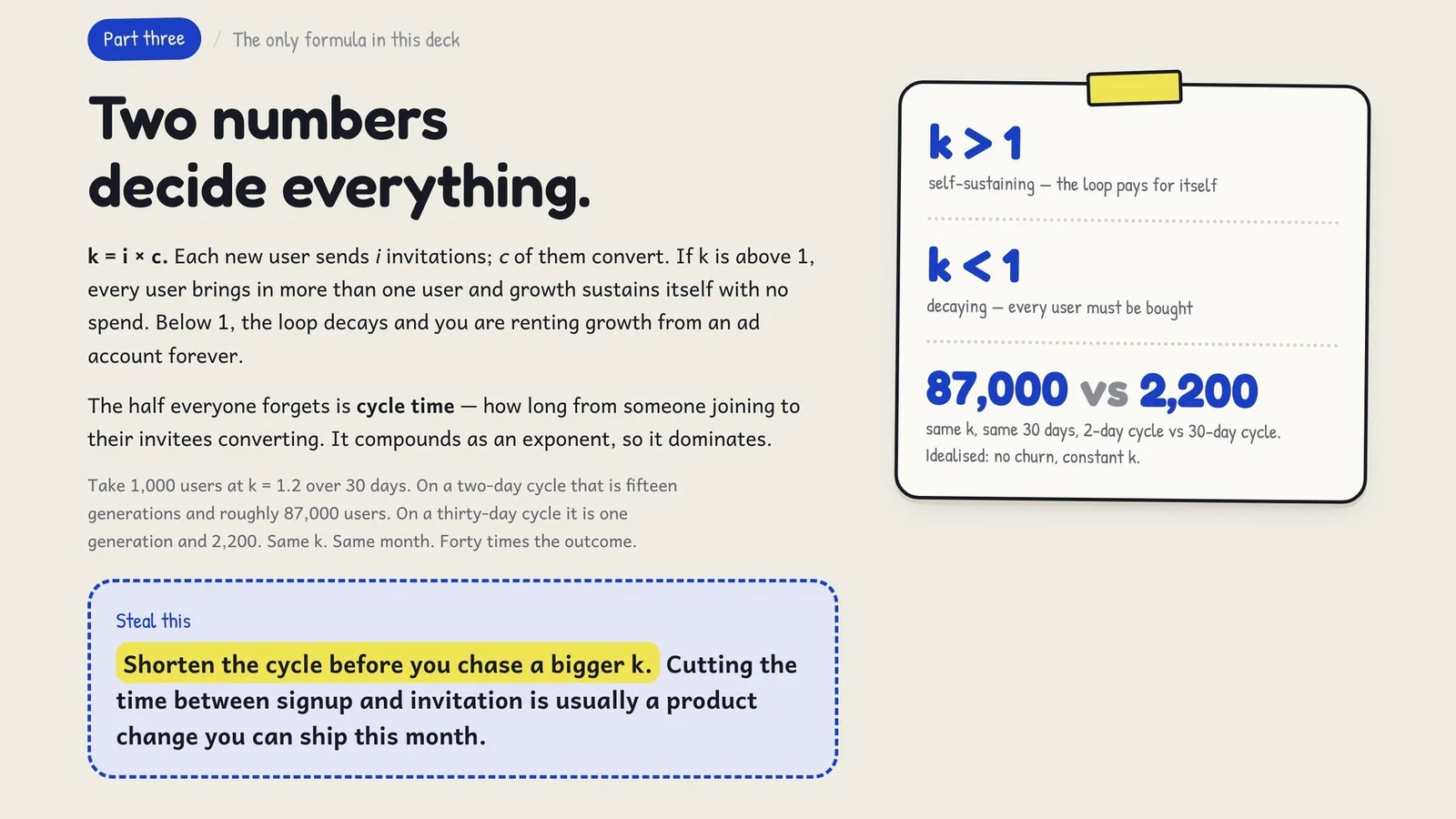
  20. k = i × c. Above 1 the loop pays for itself; below 1 every user must be bought. Cycle time compounds as an exponent — same k over 30 days gives 87,000 users on a two-day cycle versus 2,200 on a thirty-day one. Steal this: shorten the cycle before you chase a bigger k. 20 Two numbers decide everything
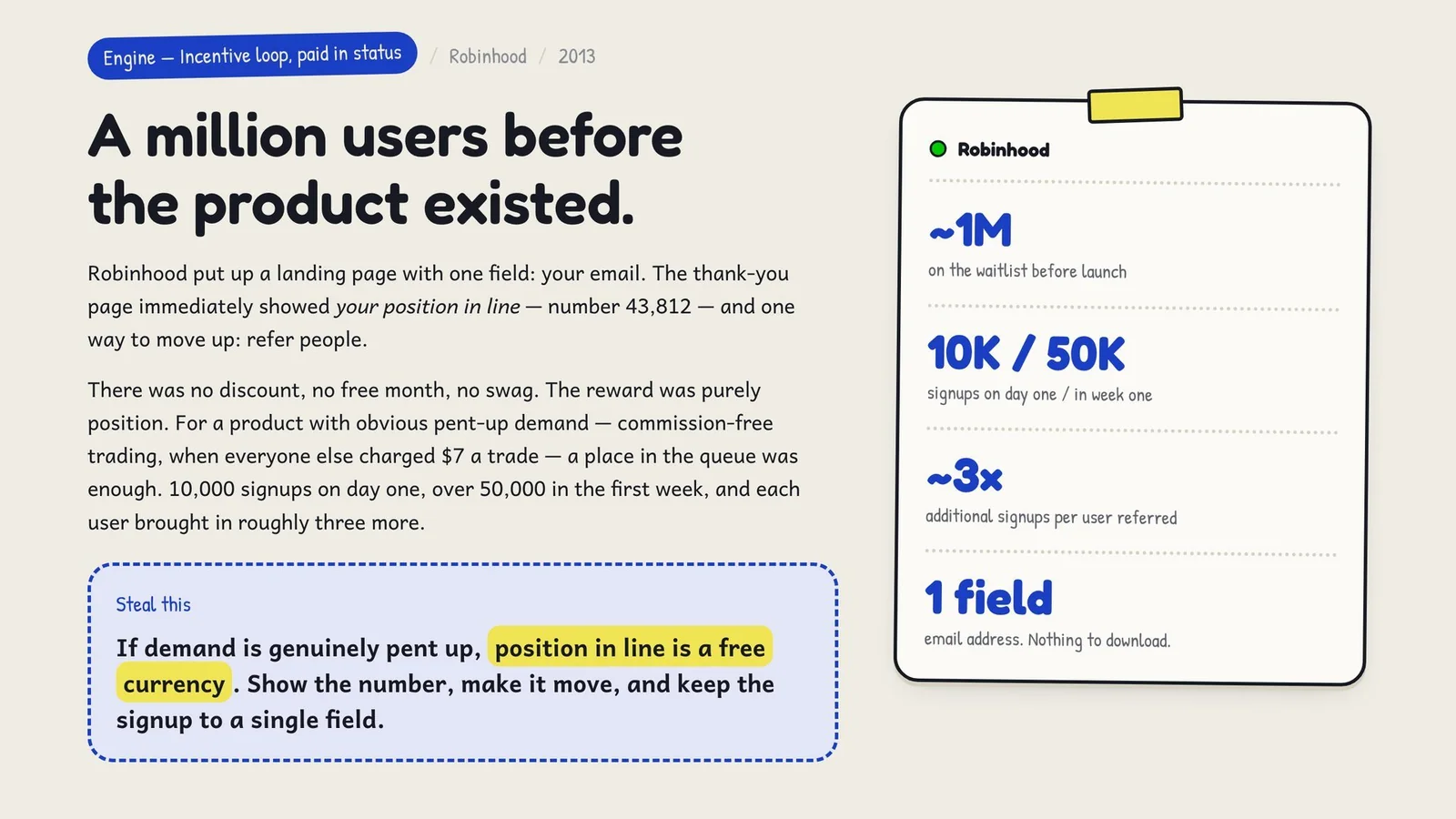
  21. A landing page with one field, a thank-you page showing your position in line, and one way to move up: refer people. 10,000 signups on day one, 50,000 in week one, about 3 more users per referrer. Steal this: if demand is pent up, position in line is a free currency. 21 Robinhood: a million users before the product existed
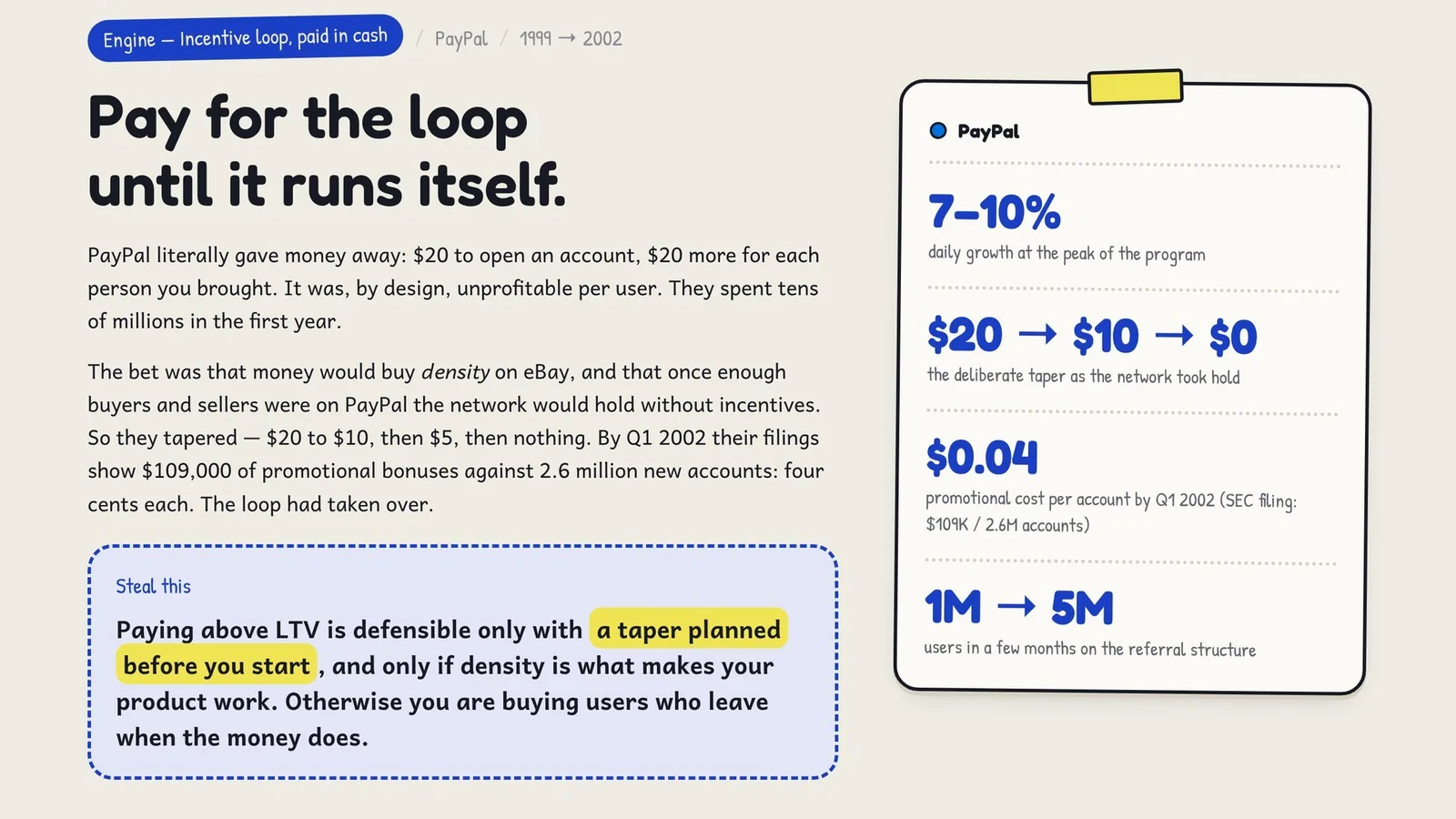
  22. $20 to open an account and $20 per referral, deliberately unprofitable, then tapered to $10, $5 and nothing. By Q1 2002 promotional cost was $0.04 per account. Steal this: paying above LTV is defensible only with a taper planned before you start. 22 PayPal: pay for the loop until it runs itself
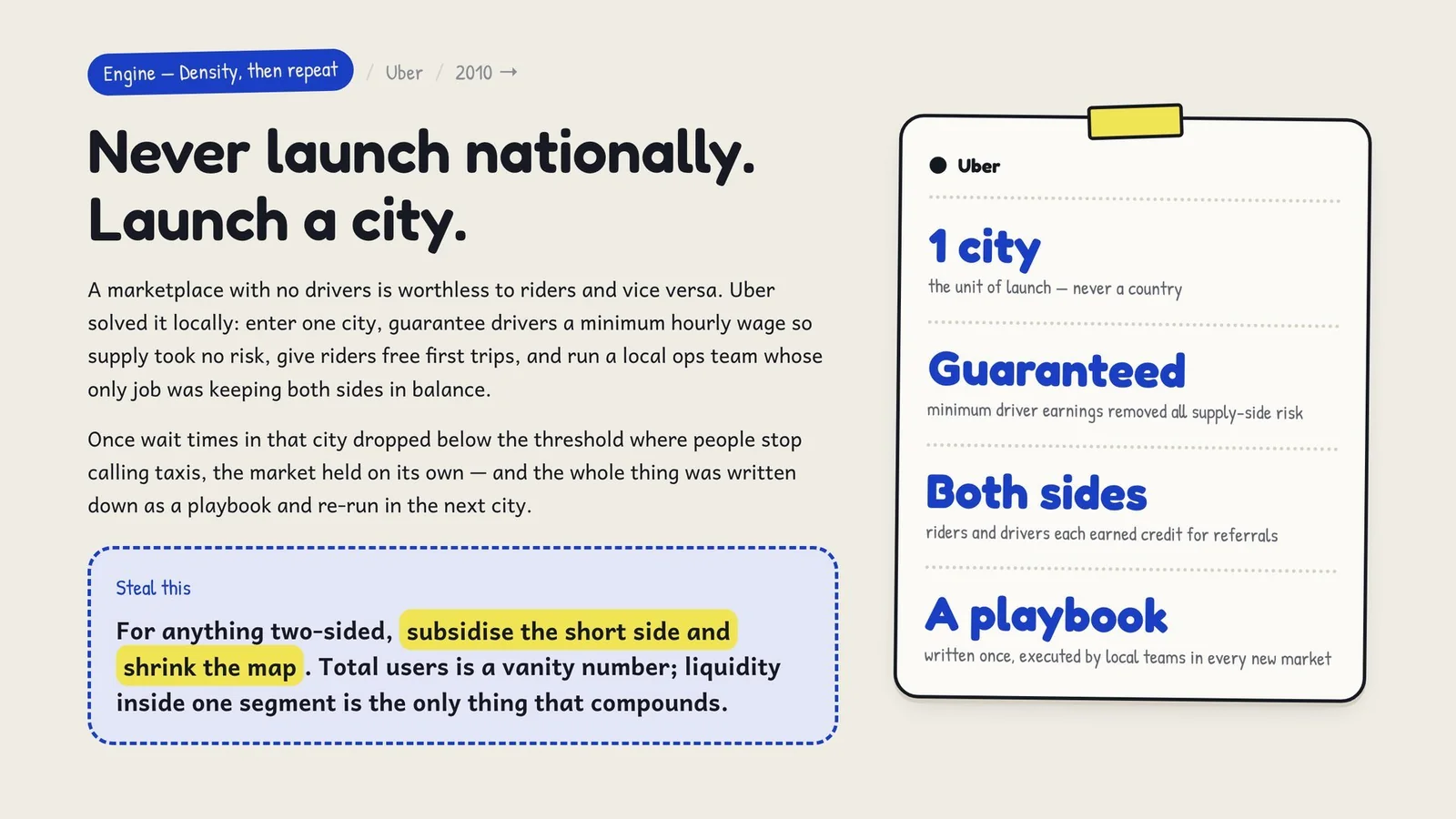
  23. Guaranteed driver earnings, free first rides, and a local ops team per city — written down once as a playbook and re-run in the next market. Steal this: for anything two-sided, subsidise the short side and shrink the map. 23 Uber: never launch nationally, launch a city
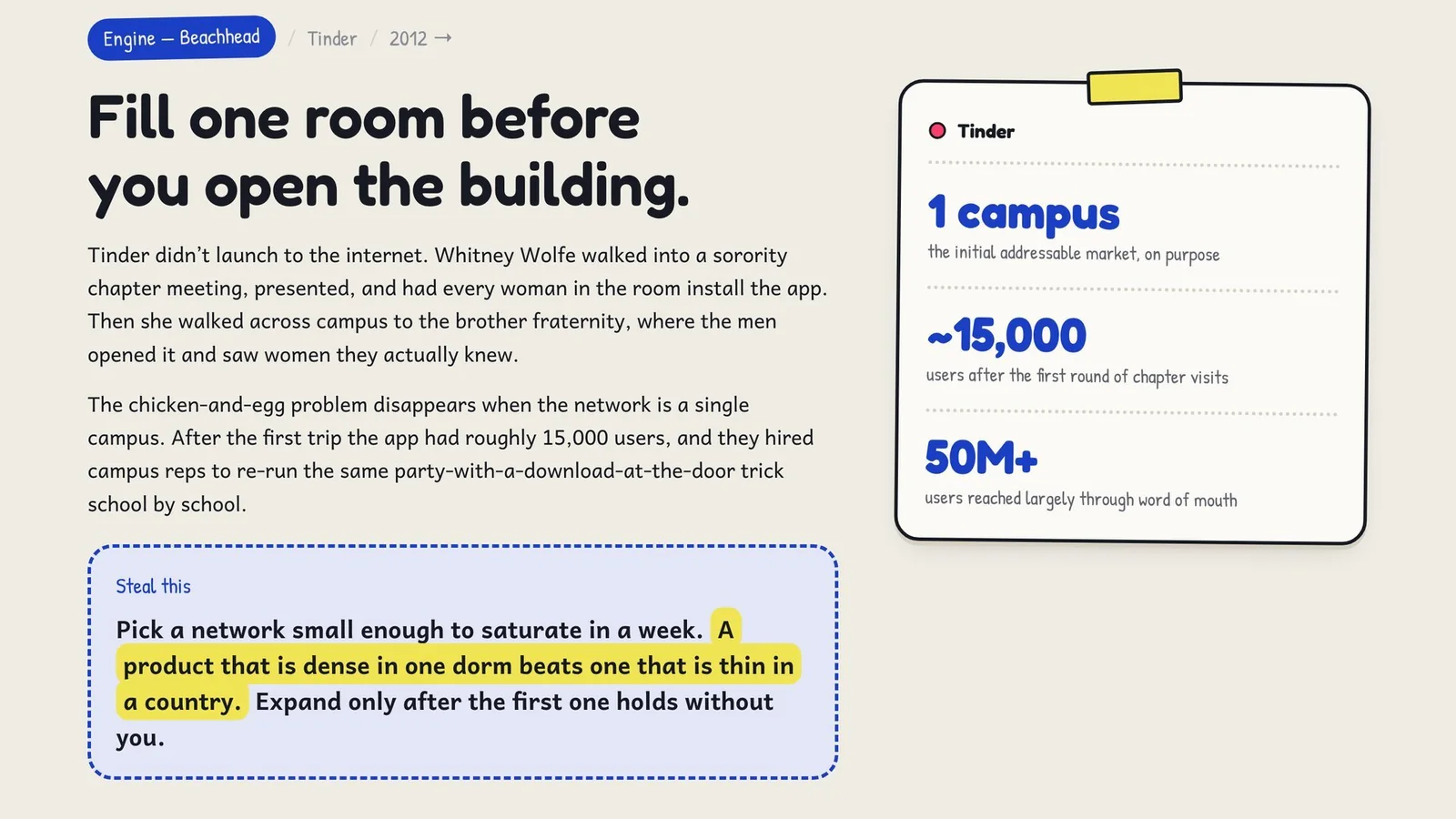
  24. Whitney Wolfe presented at a sorority chapter meeting, had every woman install the app, then walked to the fraternity — about 15,000 users after the first round of chapter visits, 50M+ largely through word of mouth. Steal this: pick a network small enough to saturate in a week. 24 Tinder: fill one room before you open the building
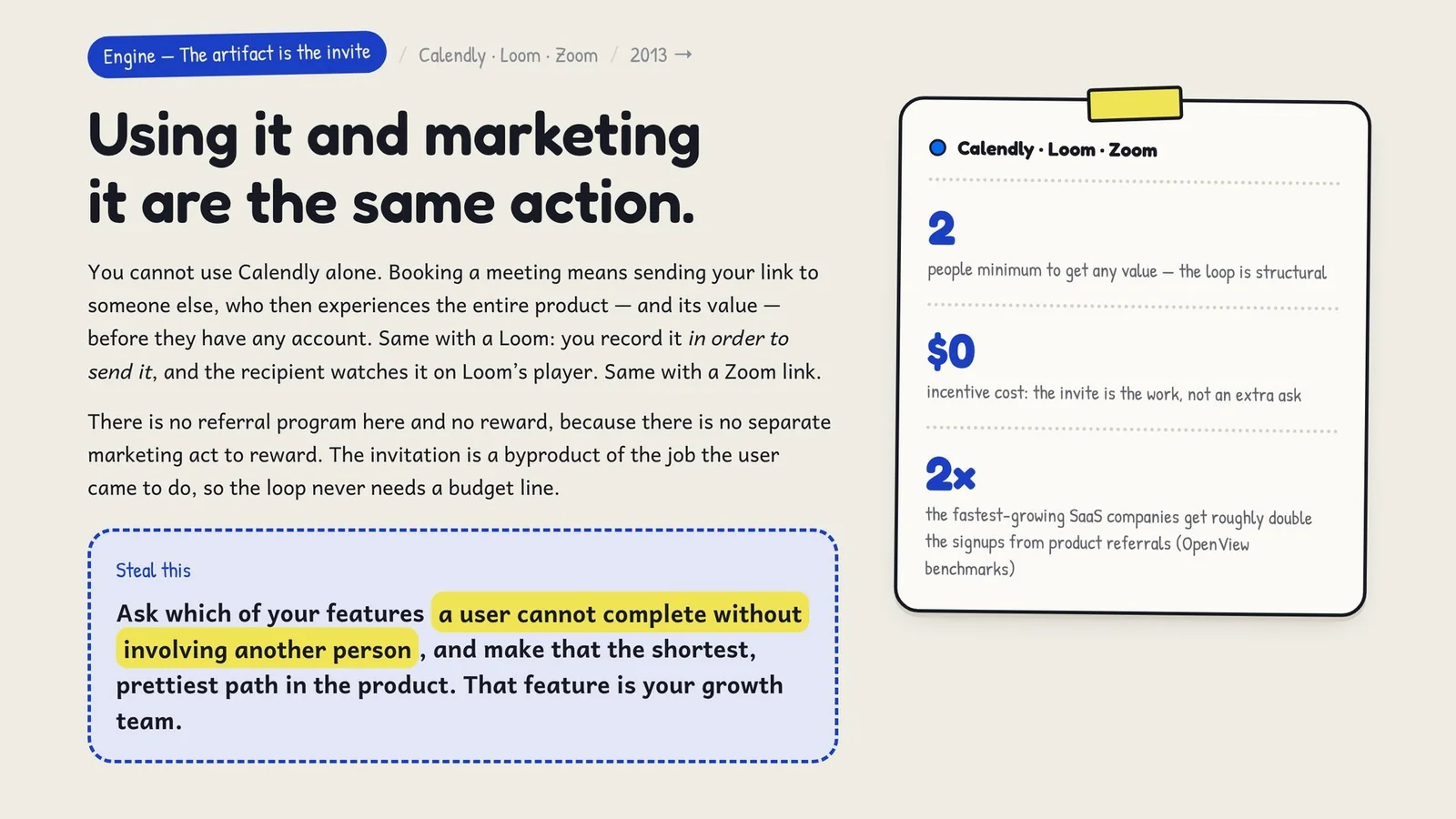
  25. You cannot use these products alone — sending the link is the job, so the invitation is a byproduct rather than a marketing ask, at $0 incentive cost. Steal this: find the feature a user cannot complete without involving another person, and make it the prettiest path in the product. 25 Calendly, Loom and Zoom: using it and marketing it are the same action
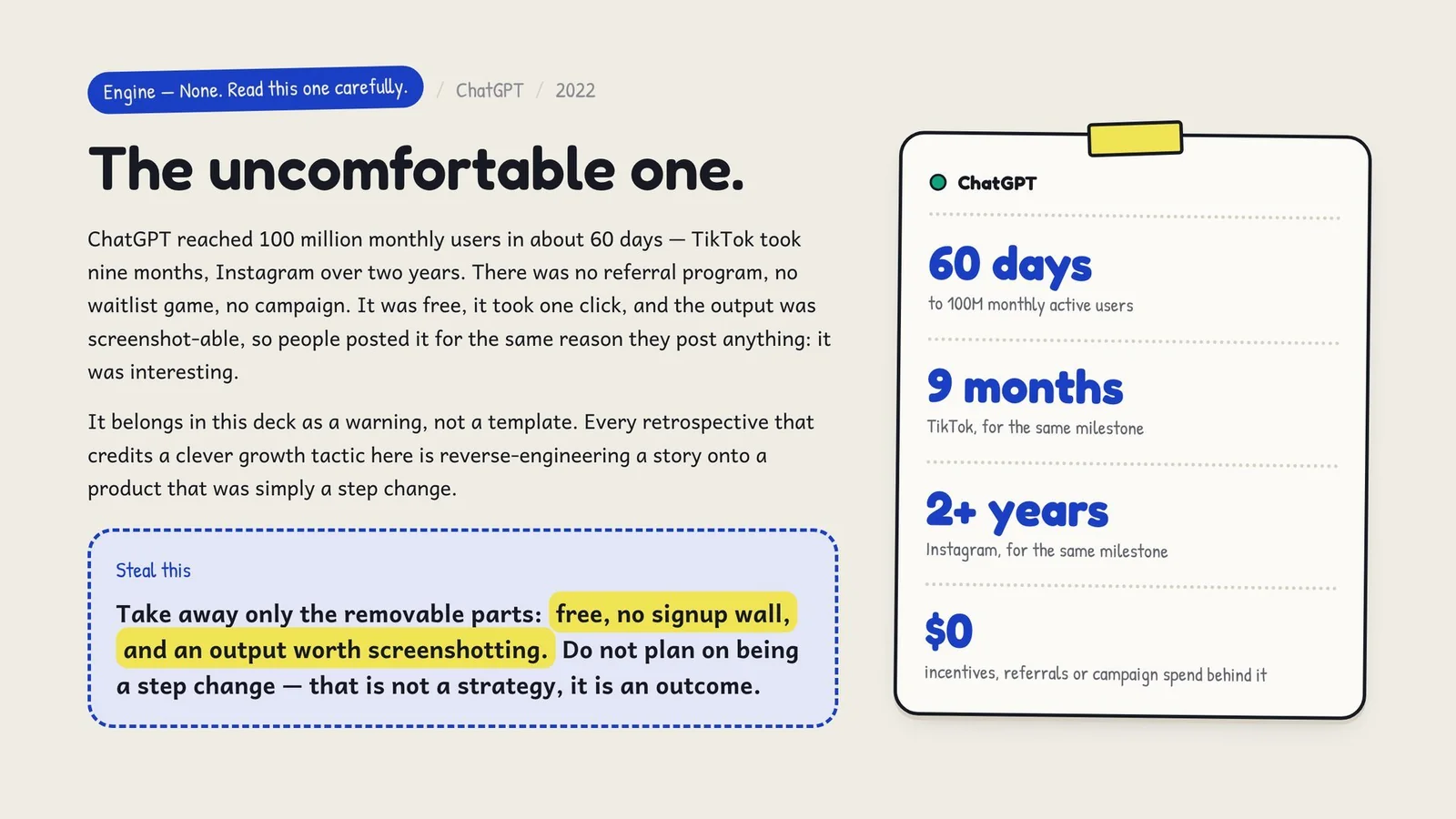
  26. 100 million monthly users in about 60 days with no referral program, no waitlist and no campaign — nine months for TikTok, two-plus years for Instagram. It belongs here as a warning, not a template: free, no signup wall, and an output worth screenshotting are the only removable parts. 26 ChatGPT: the uncomfortable one
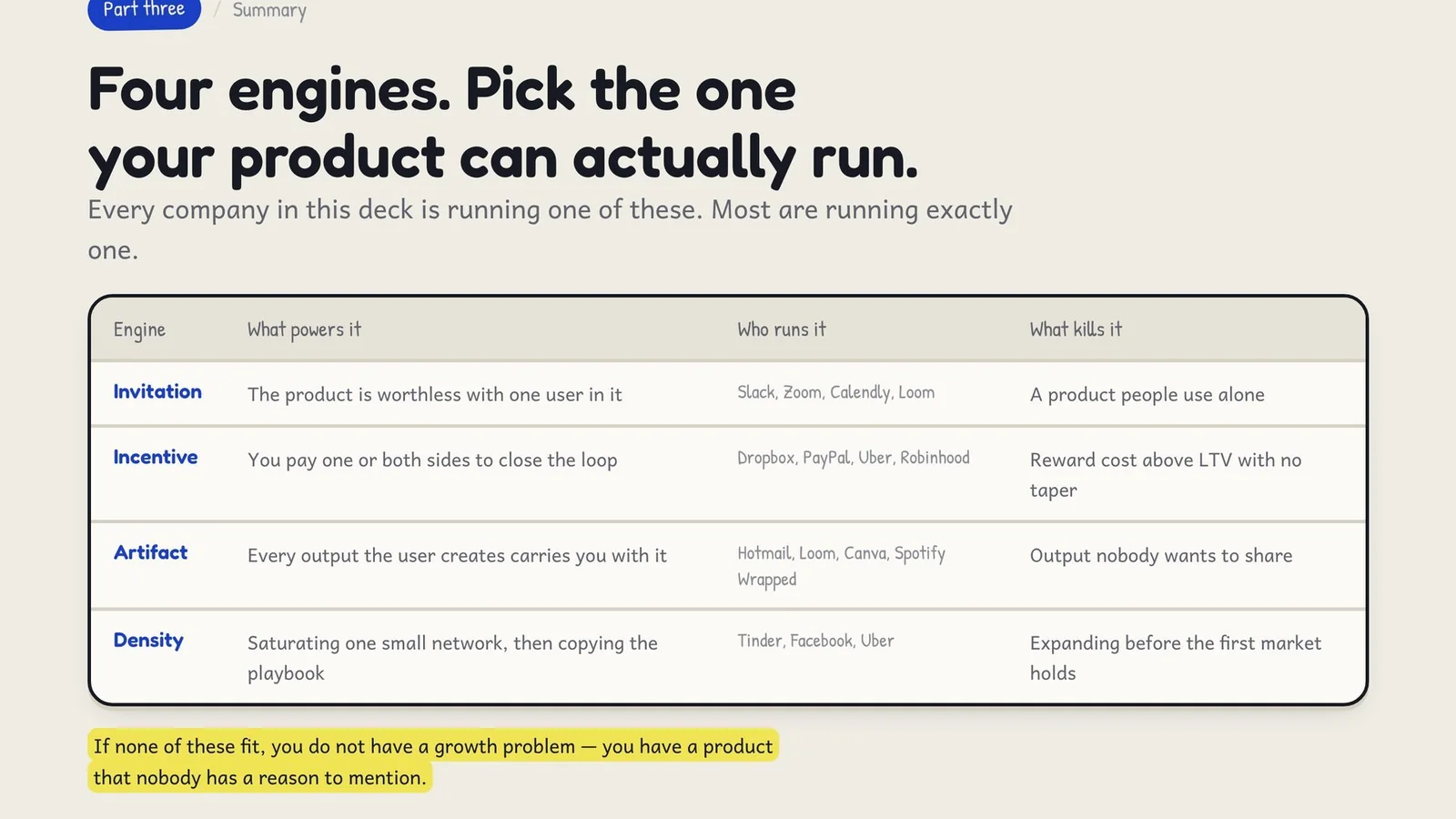
  27. A table of the four engines — invitation, incentive, artifact and density — what powers each, who runs it, and what kills it. If none of them fit, you do not have a growth problem; you have a product nobody has a reason to mention. 27 Four engines: pick the one your product can actually run
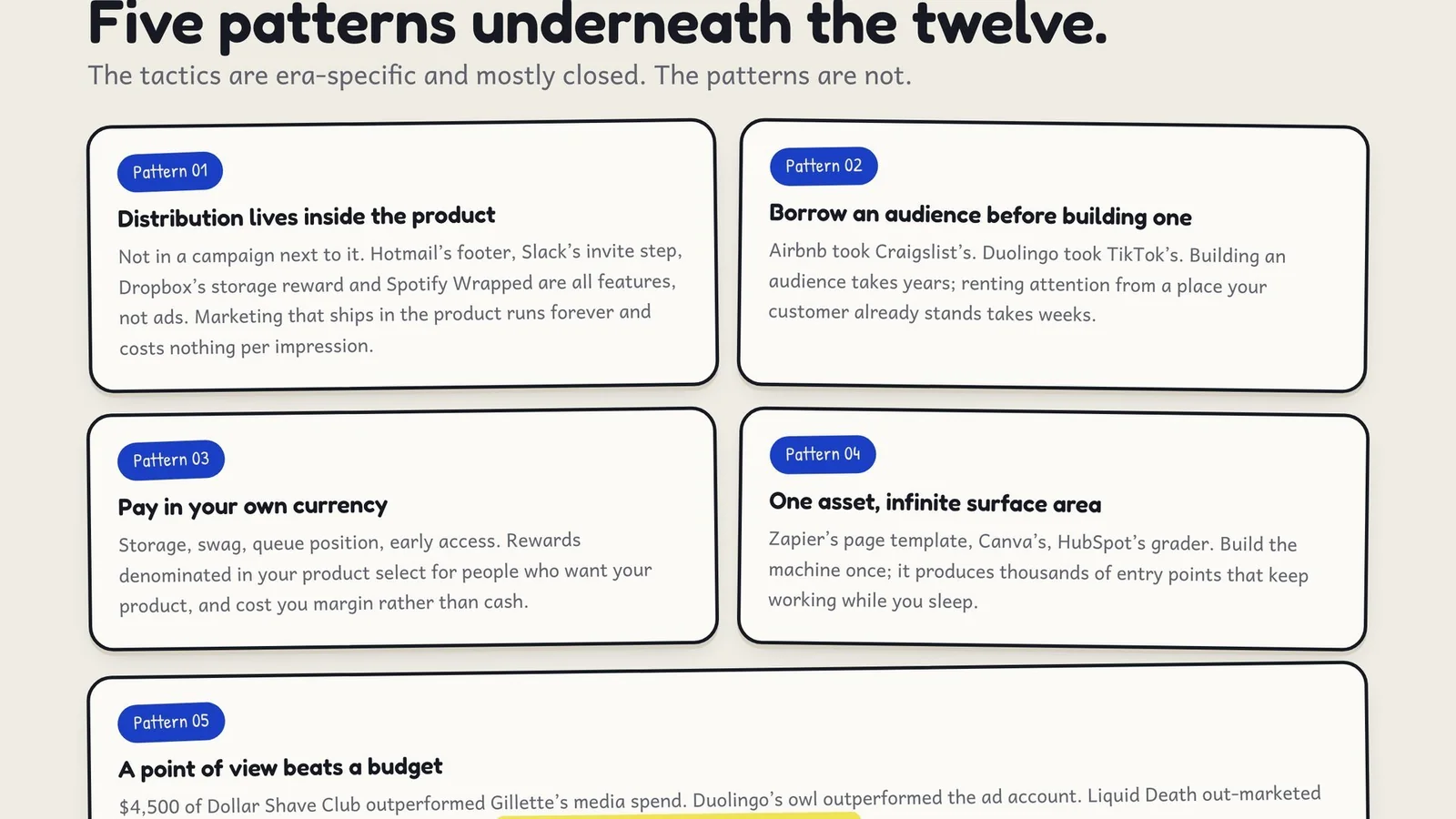
  28. Distribution lives inside the product; borrow an audience before building one; pay in your own currency; one asset, infinite surface area; and a point of view beats a budget. 28 Five patterns underneath the twelve
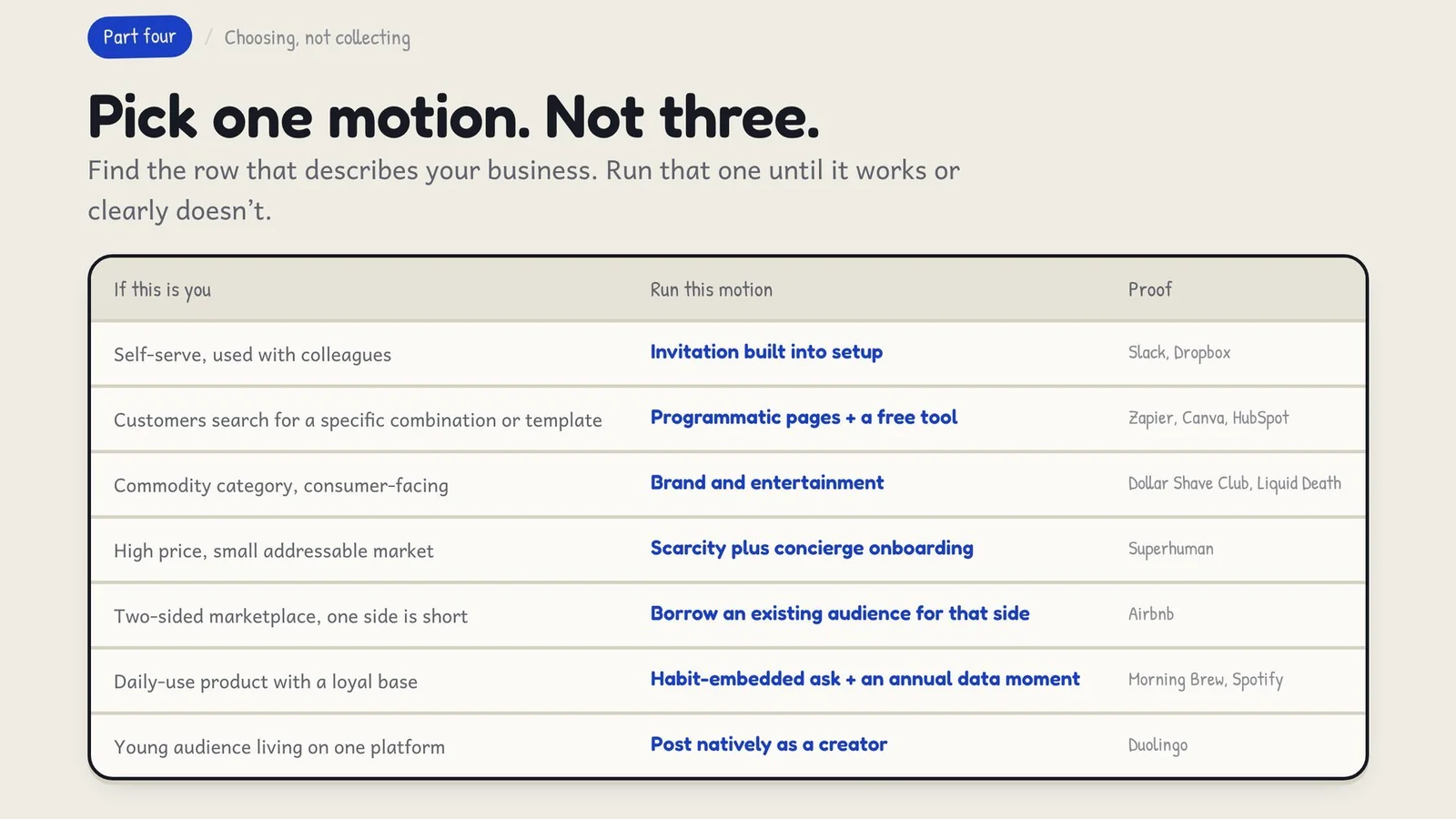
  29. A table matching your business to one motion: invitation built into setup, programmatic pages plus a free tool, brand and entertainment, scarcity plus concierge onboarding, borrowing an existing audience, a habit-embedded ask, or posting natively as a creator. 29 Pick one motion, not three
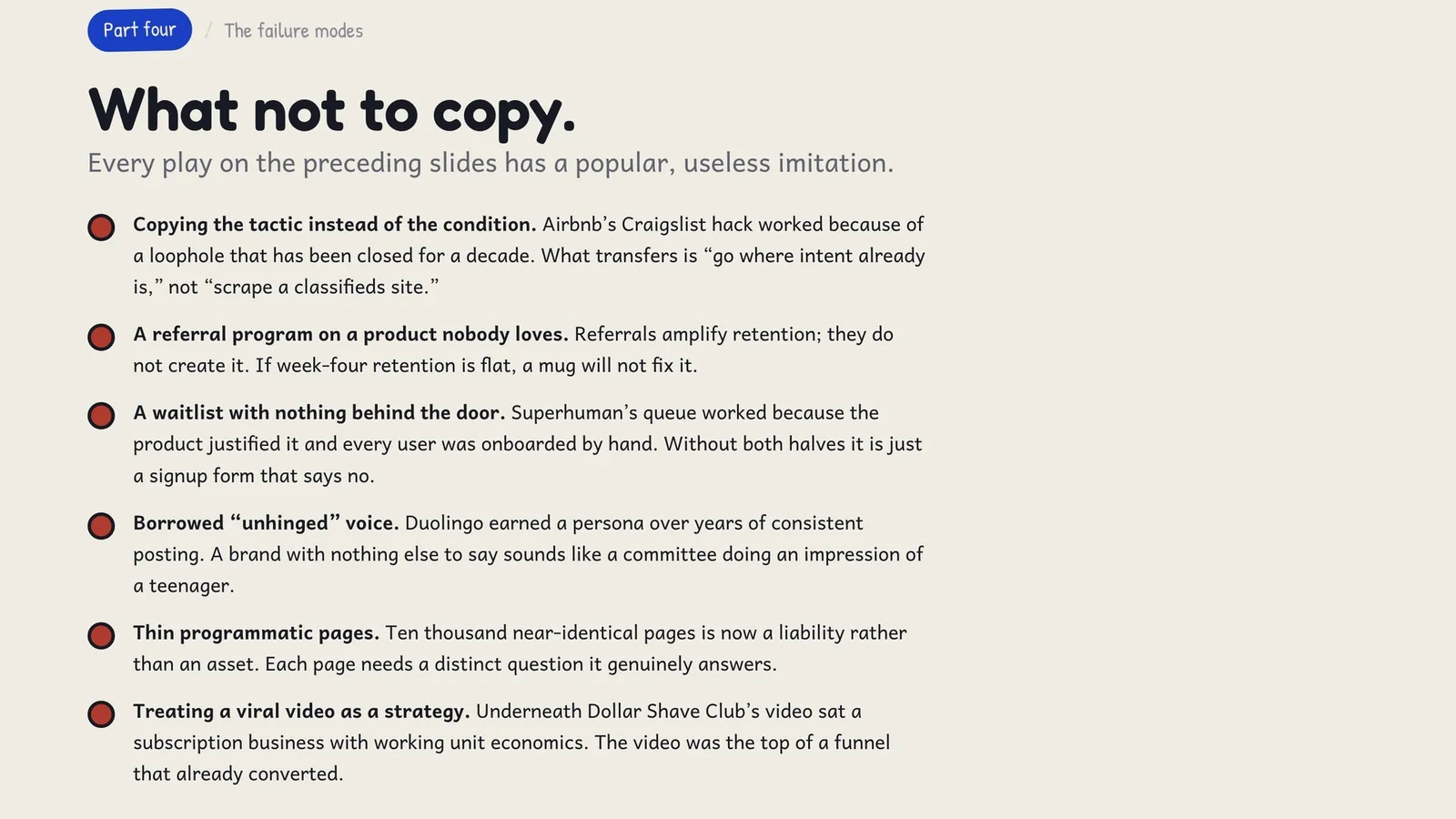
  30. The failure modes: copying the tactic instead of the condition, a referral program on a product nobody loves, a waitlist with nothing behind the door, a borrowed unhinged voice, thin programmatic pages, and treating a viral video as a strategy. 30 What not to copy
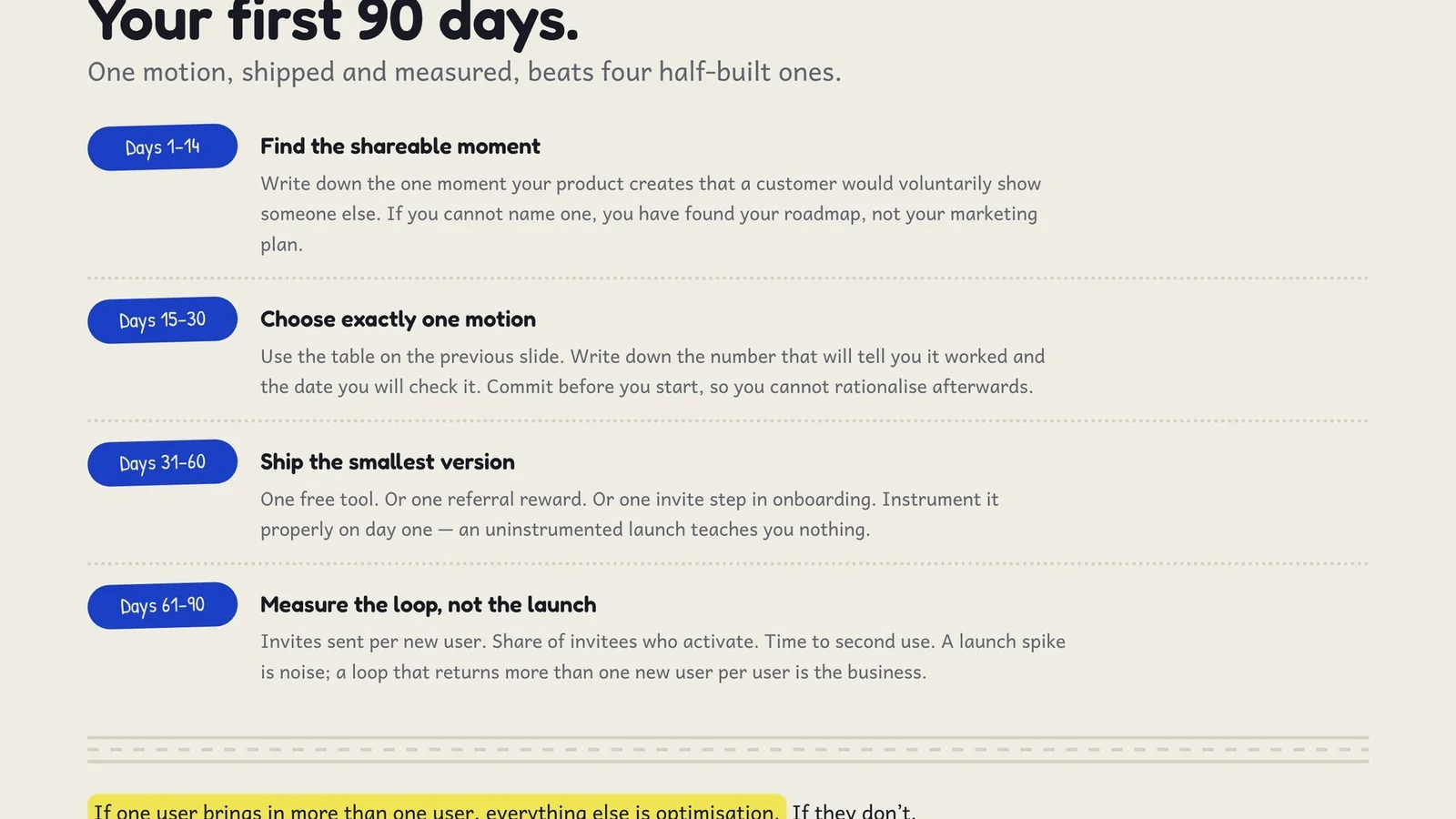
  31. Days 1–14, find the shareable moment. Days 15–30, choose exactly one motion and the number that will tell you it worked. Days 31–60, ship the smallest instrumented version. Days 61–90, measure the loop, not the launch. 31 Your first 90 days
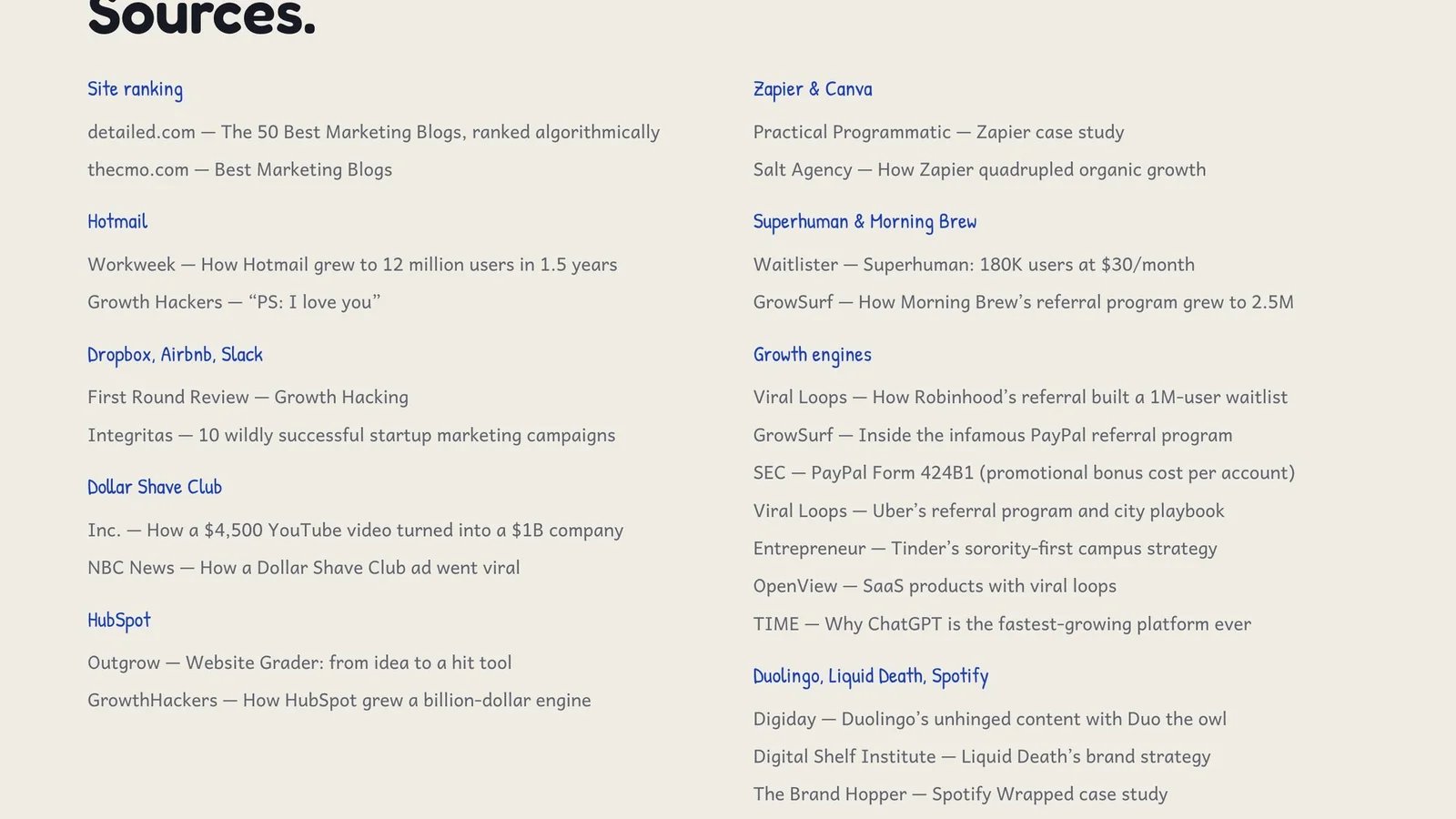
  32. Every figure in the deck attributed to its published account — the site ranking, and the sources behind each of the twelve campaigns and the growth engines. 32 Sources

The short version

  • Distribution lives inside the product. Hotmail's footer, Slack's invite step, Dropbox's storage reward and Spotify Wrapped are features, not ads. Marketing that ships in the product runs forever and costs nothing per impression.
  • Borrow an audience before building one. Airbnb took Craigslist's; Duolingo took TikTok's. Building an audience takes years; renting attention where your customer already stands takes weeks.
  • Pay in your own currency. Storage, swag, queue position, early access. Rewards denominated in your product select for people who want the product, and cost you margin rather than cash.
  • One asset, infinite surface area. Zapier's page template, HubSpot's grader. Build the machine once; it produces thousands of entry points that keep working while you sleep.
  • A point of view beats a budget. $4,500 of Dollar Shave Club outperformed Gillette's media spend.

Underneath all twelve sit four engines — invitation, incentive, artifact, density — and one piece of arithmetic: k = i × c. Above 1 the loop pays for itself; below 1 you are renting growth from an ad account forever. The half everyone forgets is cycle time, which compounds as an exponent: same k over the same month is 87,000 users on a two-day cycle and 2,200 on a thirty-day one.

Want this delivered to your team, or help picking which motion your product can actually run? Book a call.