Doron Segal Founder · CTO · YC W21 Book a call
TALK

Loyalty by an Engineer

23 slides 3 cases 1 formula Starbucks FY25 – 26 Download the deck (PDF)
Use ← → to move · G for the grid
  1. Title slide: a guest lecture on CRM — why Starbucks is quietly a $1.8B bank, why the goldfish statistic is a lie, and how a café with one location can own its customers instead of renting them from a marketplace. 1 Loyalty by an Engineer
  2. Opening: after 100+ slides this semester, here is one more — this one comes with caffeine, and every number has a name attached. Not a CRM theory lecture, but how customer relationships are built from inside a startup that runs ordering and loyalty for thousands of coffee shops. 2 Yet another cool slide
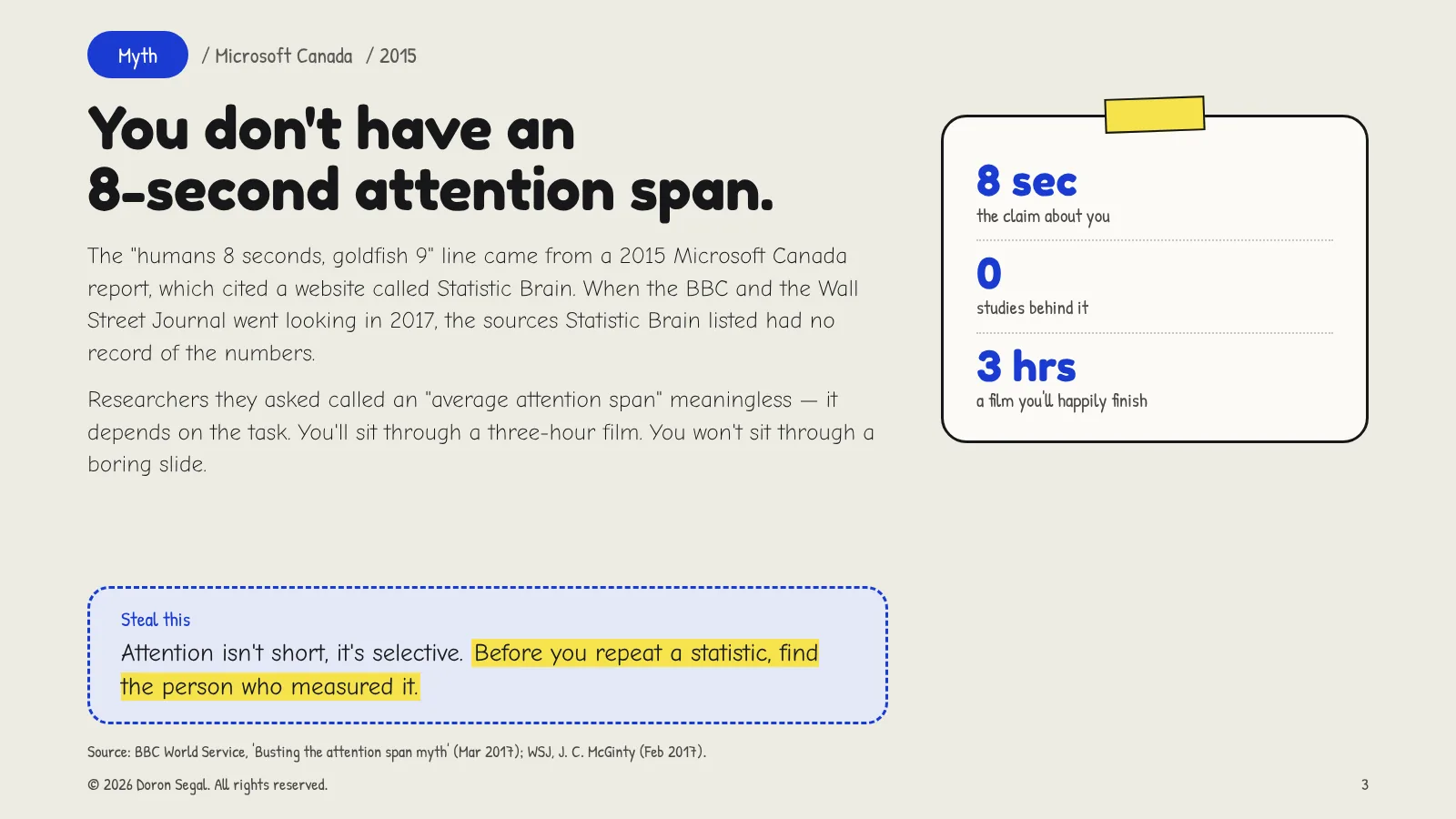
  3. Myth: the claim that humans have an 8-second attention span, shorter than a goldfish's 9, came from a 2015 Microsoft Canada report citing Statistic Brain, whose own listed sources had no record of it when the BBC and WSJ checked in 2017. Attention is task-dependent. Steal this: before you repeat a statistic, find the person who measured it. 3 The 8-second goldfish is a myth
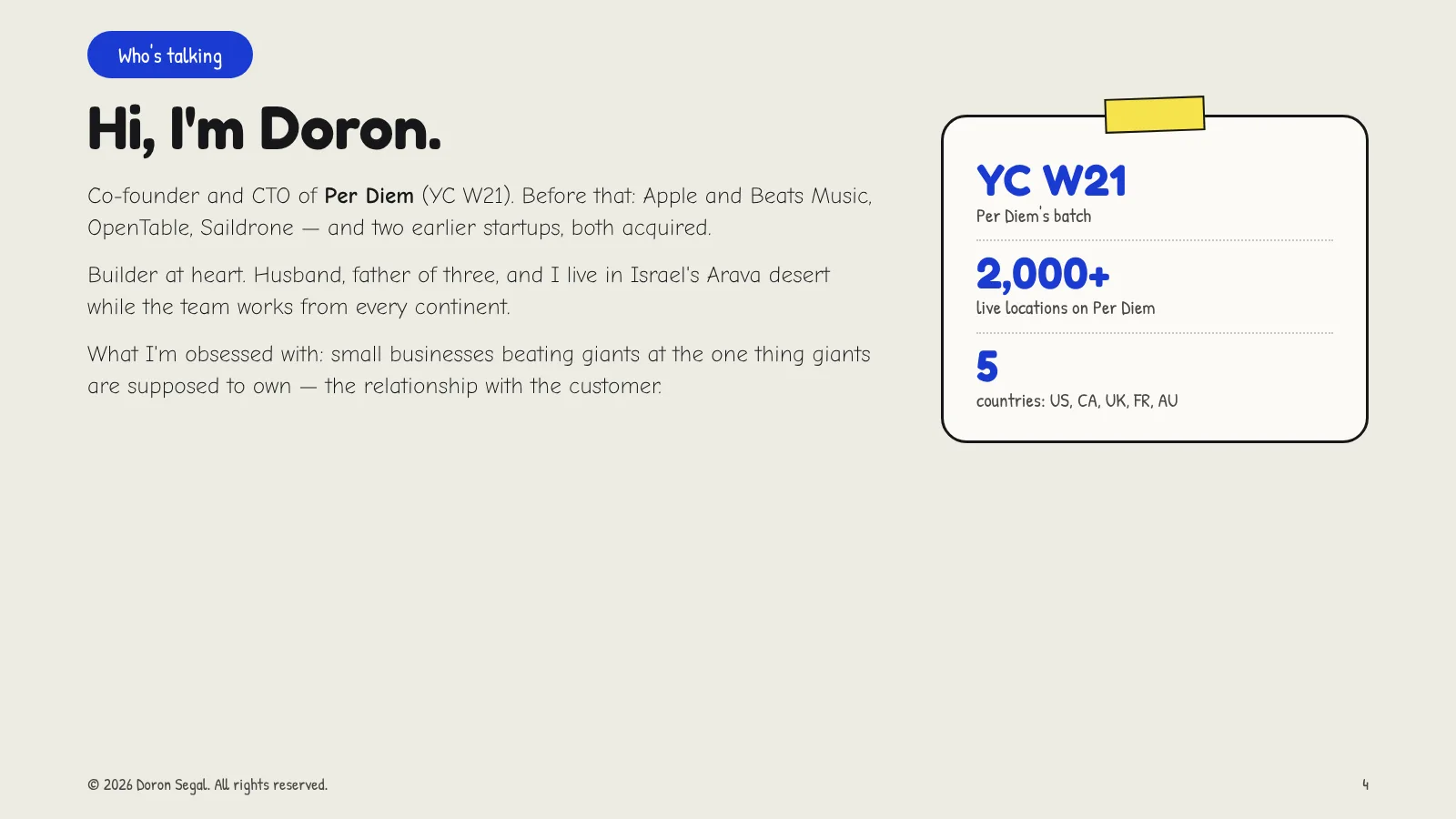
  4. Introduction: co-founder and CTO of Per Diem (YC W21); previously Apple and Beats Music, OpenTable and Saildrone, and two acquired startups. Lives in Israel's Arava desert with a team on every continent. Per Diem runs 2,000+ live locations across the US, Canada, the UK, France and Australia. 4 Hi, I'm Doron
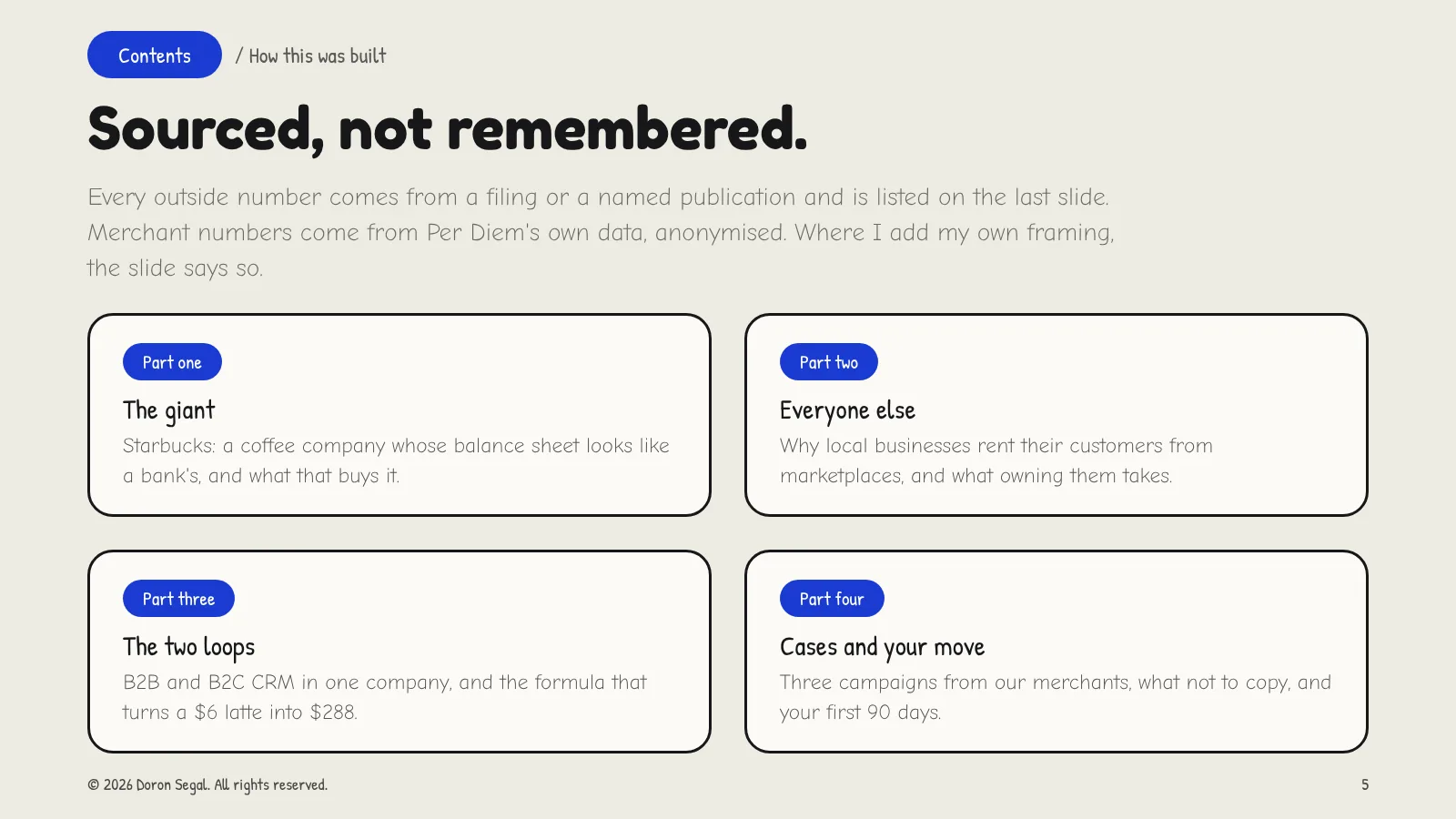
  5. Contents: outside numbers come from filings or named publications and are listed on the last slide; merchant numbers are Per Diem's own data, anonymised. Four parts — the giant, everyone else, the two loops, and cases and your move. 5 Sourced, not remembered
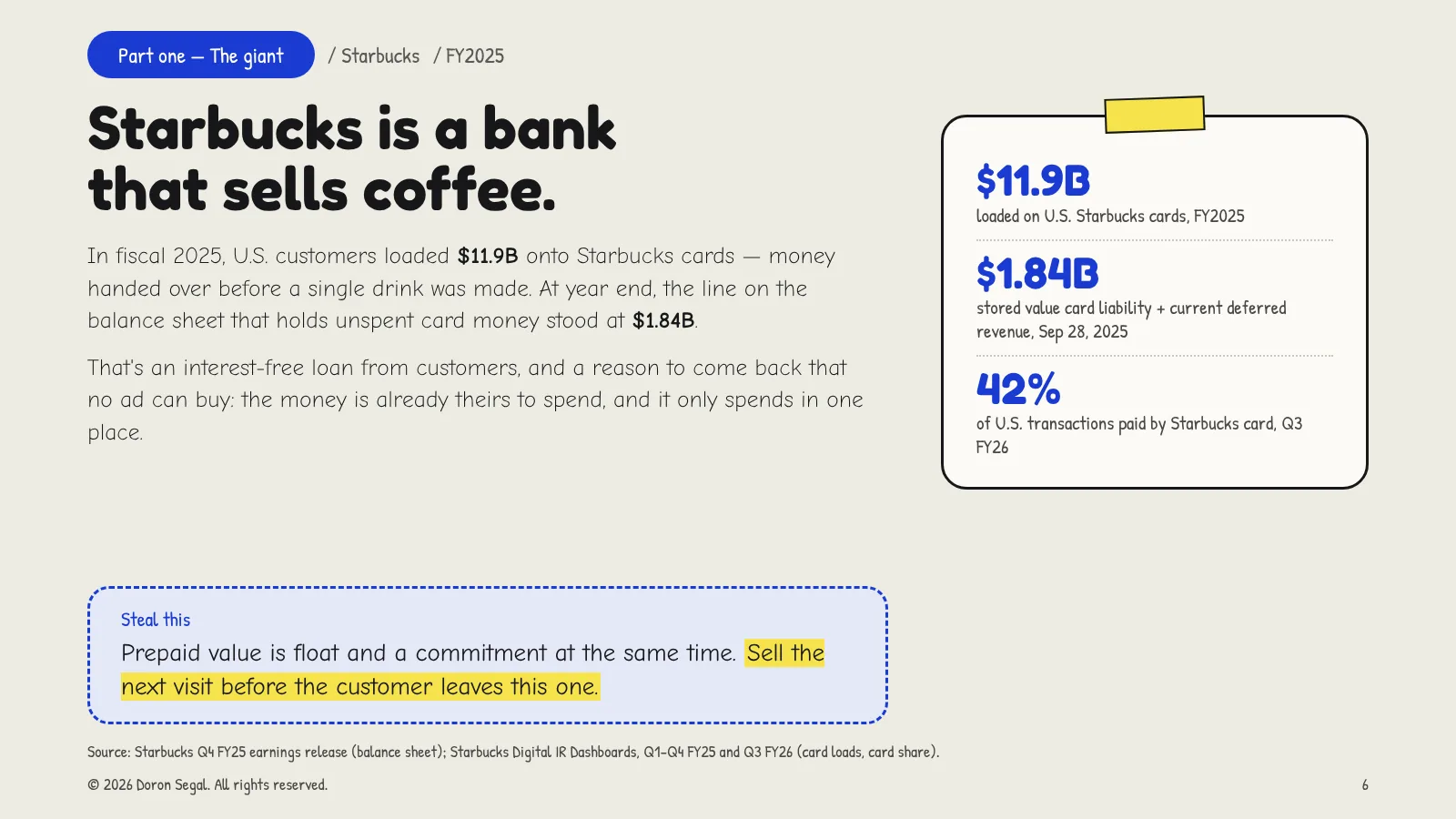
  6. Starbucks as a bank: U.S. customers loaded $11.9B onto Starbucks cards in fiscal 2025, and the balance-sheet line holding stored value card liability and current deferred revenue stood at $1.84B on September 28, 2025. Cards paid for 42% of U.S. transactions in Q3 FY26. Steal this: sell the next visit before the customer leaves this one. 6 Starbucks is a bank that sells coffee
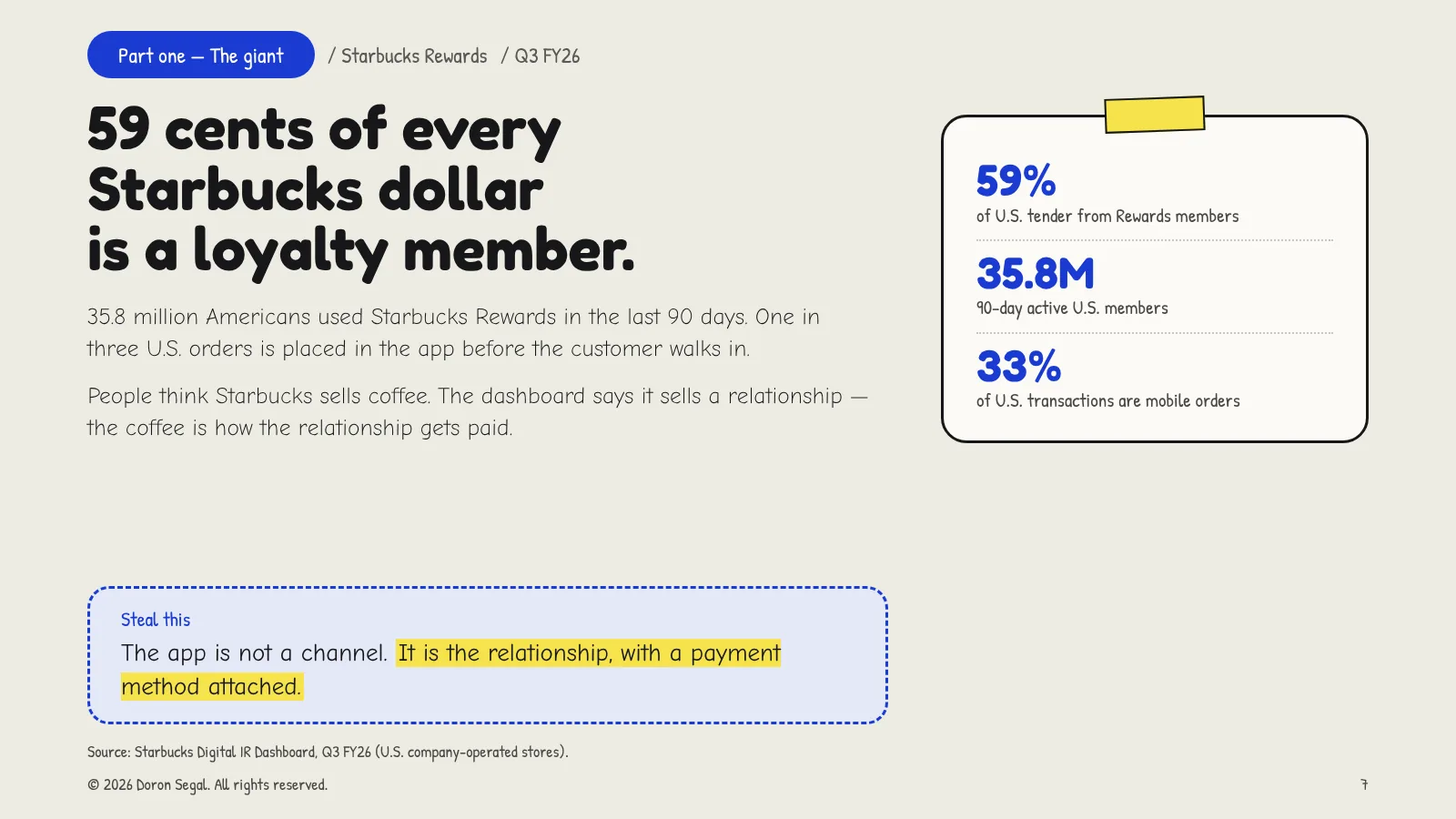
  7. Starbucks Rewards in Q3 FY26: members account for 59% of U.S. tender, 35.8 million U.S. members were active in the last 90 days, and mobile orders are 33% of U.S. company-operated transactions. Steal this: the app is not a channel; it is the relationship with a payment method attached. 7 59 cents of every Starbucks dollar
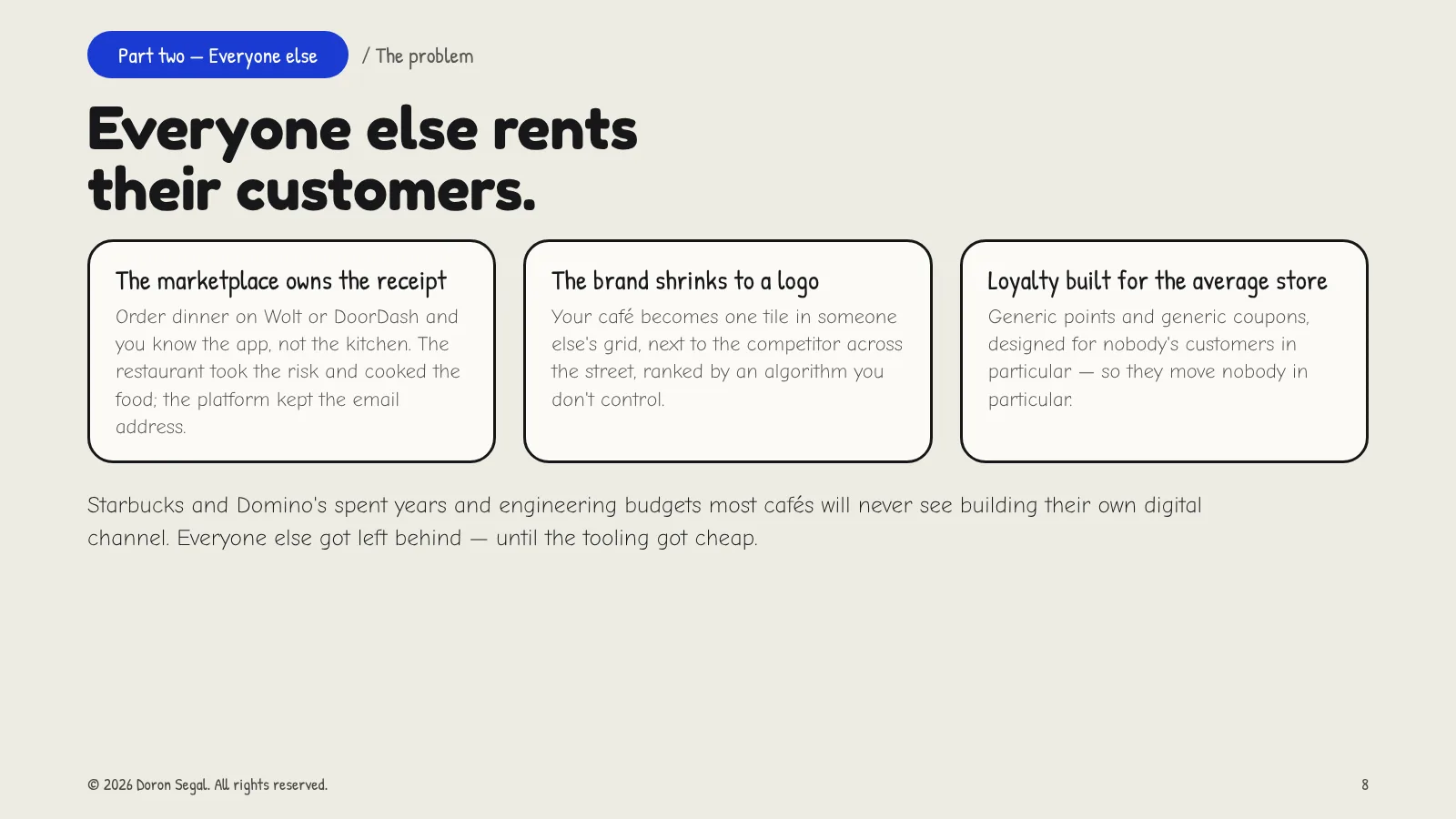
  8. The problem: local businesses rely on third-party marketplaces that own the customer relationship and the data, reduce the brand to a logo in someone else's grid, and offer generic loyalty designed for the average store. Starbucks and Domino's built their own channels; everyone else was left behind until the tooling got cheap. 8 Everyone else rents their customers
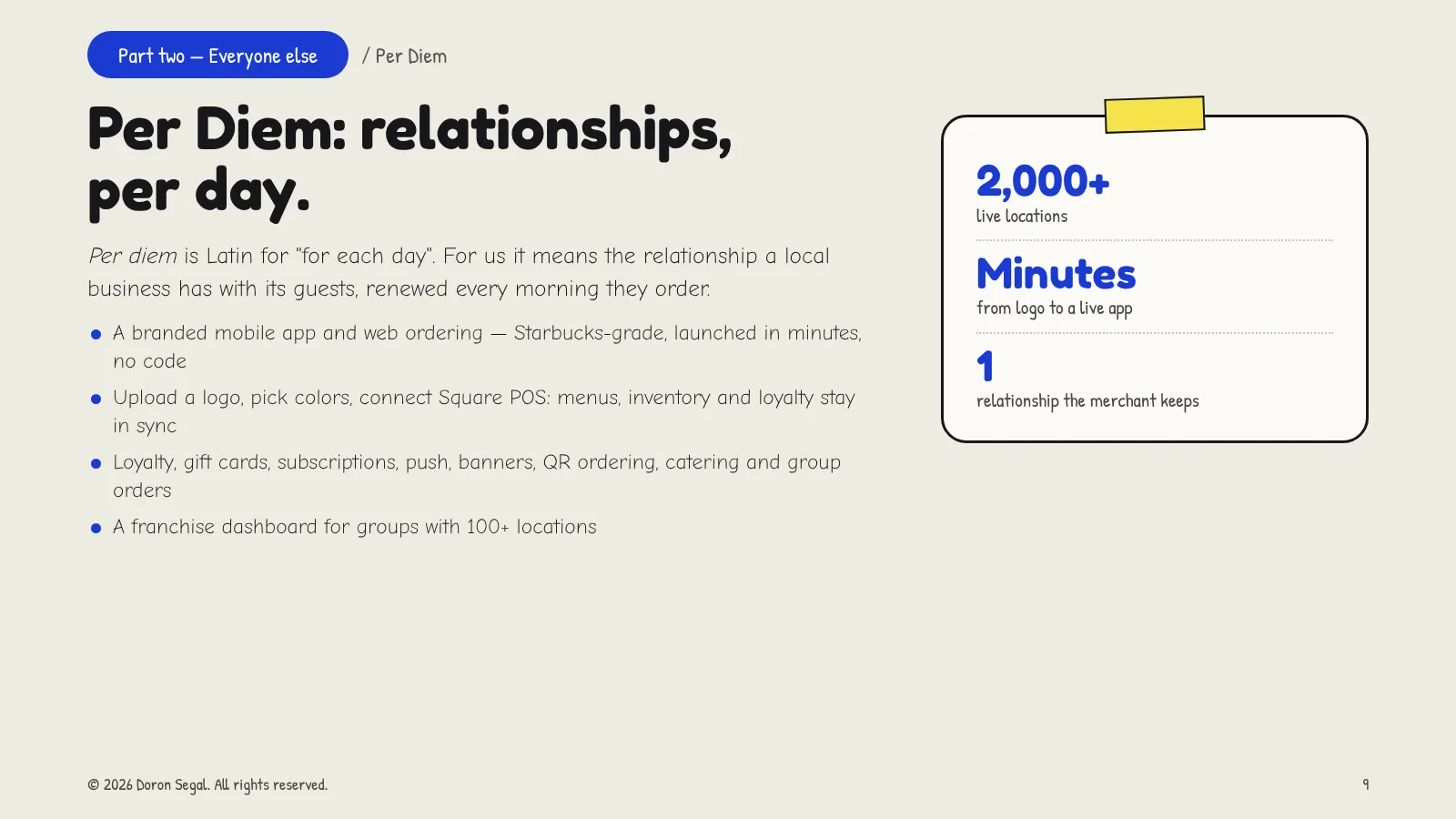
  9. Per Diem: per diem is Latin for 'for each day'; the platform gives local businesses a branded mobile app and web ordering launched in minutes on top of Square POS, with loyalty, gift cards, subscriptions, push, QR ordering, catering and a franchise dashboard for 100+ location groups. 2,000+ live locations. 9 Per Diem: relationships, per day
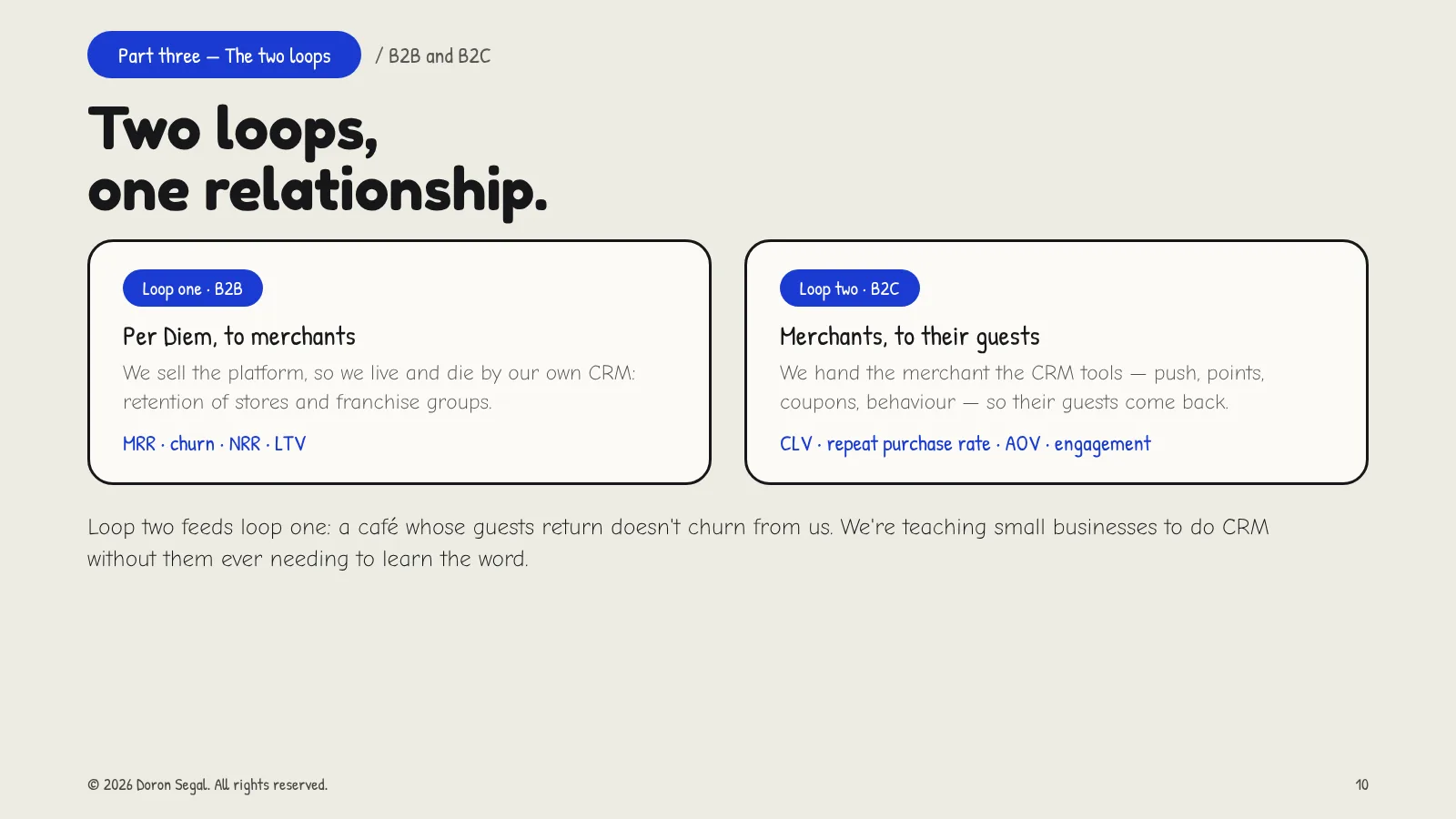
  10. Two loops of CRM: Per Diem sells to merchants (B2B, measured by MRR, churn, NRR and LTV) and gives merchants tools to keep their own guests (B2C, measured by CLV, repeat purchase rate, AOV and engagement). A café whose guests return doesn't churn. 10 Two loops, one relationship
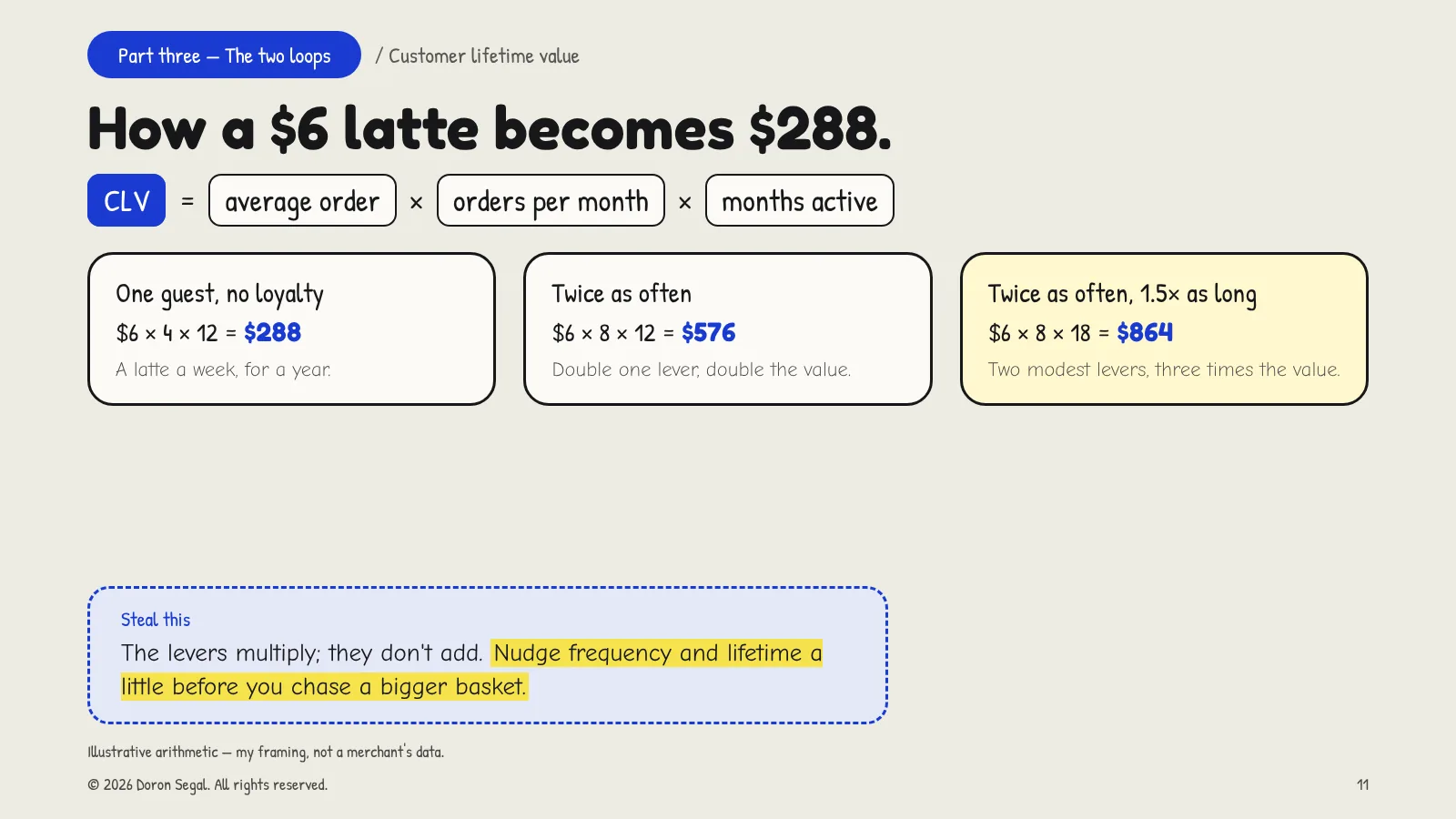
  11. Customer lifetime value equals average order times orders per month times months active. A $6 latte four times a month for a year is $288; doubling frequency gives $576; doubling frequency and staying 1.5 times as long gives $864 — three times the value. Steal this: the levers multiply, so nudge frequency and lifetime before chasing a bigger basket. Illustrative arithmetic. 11 How a $6 latte becomes $288
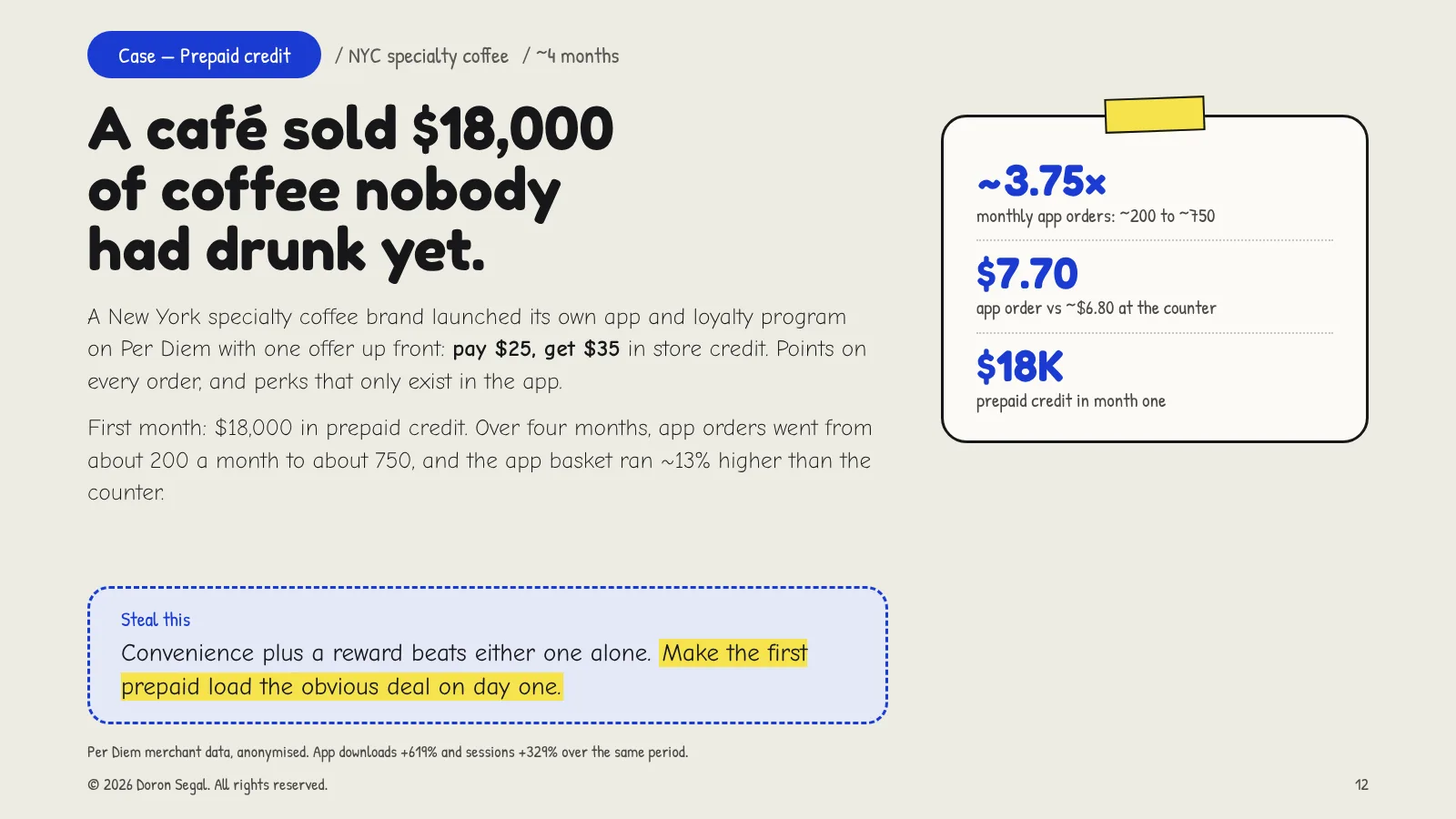
  12. Case: a New York specialty coffee brand launched an app and loyalty program on Per Diem with a pay $25, get $35 prepaid offer. First month: $18,000 in prepaid credit. Over about four months, monthly app orders grew from about 200 to about 750, app orders averaged $7.70 against about $6.80 at the counter, downloads rose 619% and sessions 329%. Per Diem merchant data, anonymised. 12 $18,000 of coffee nobody had drunk yet
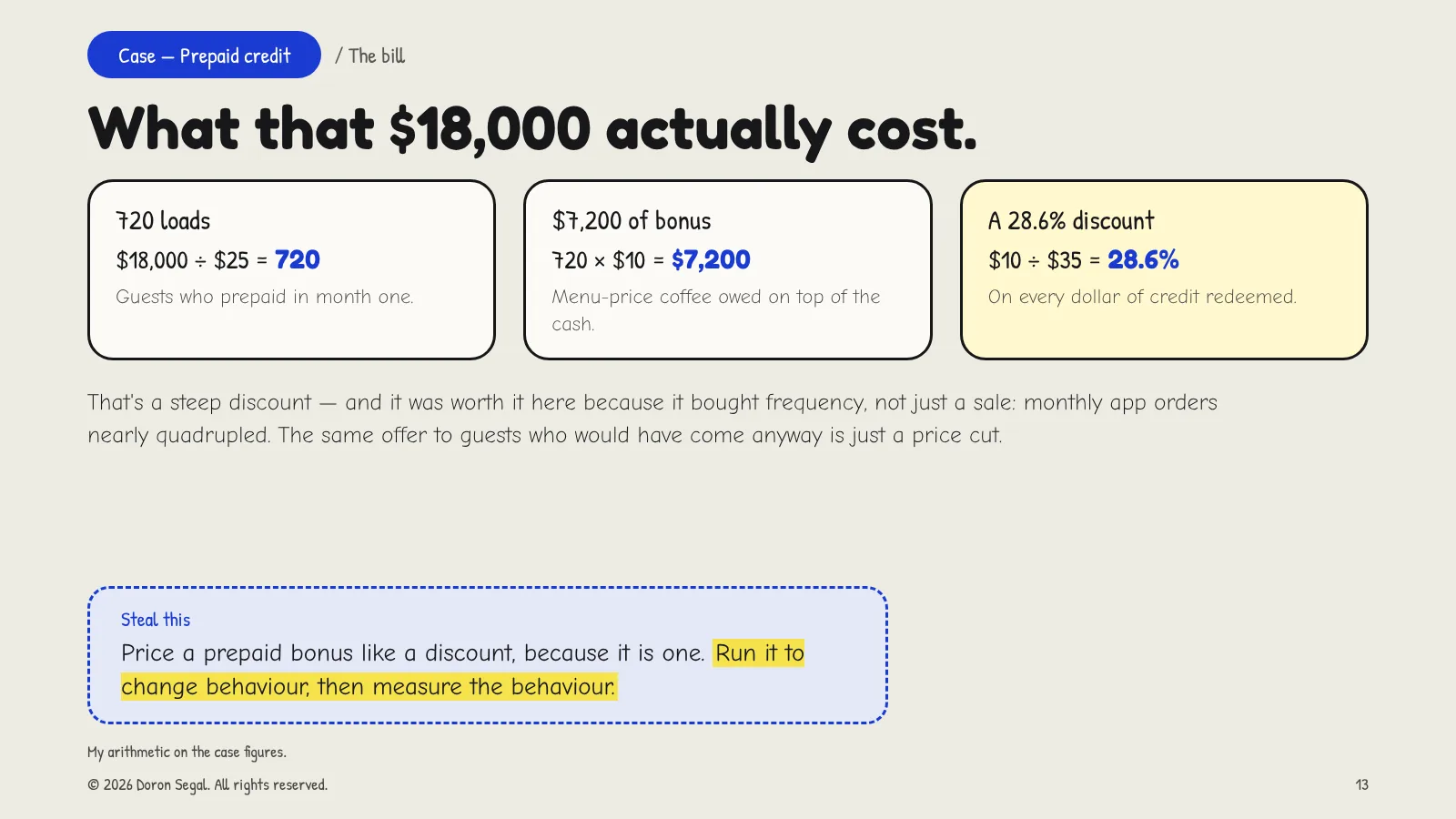
  13. The cost of the prepaid offer: $18,000 divided by $25 is 720 loads; each carried a $10 bonus, so $7,200 of menu-price coffee is owed on top of the cash — a 28.6% discount on every dollar of credit redeemed. Worth it here because monthly orders nearly quadrupled. Steal this: price a prepaid bonus like a discount and measure the behaviour it changes. 13 What that $18,000 actually cost
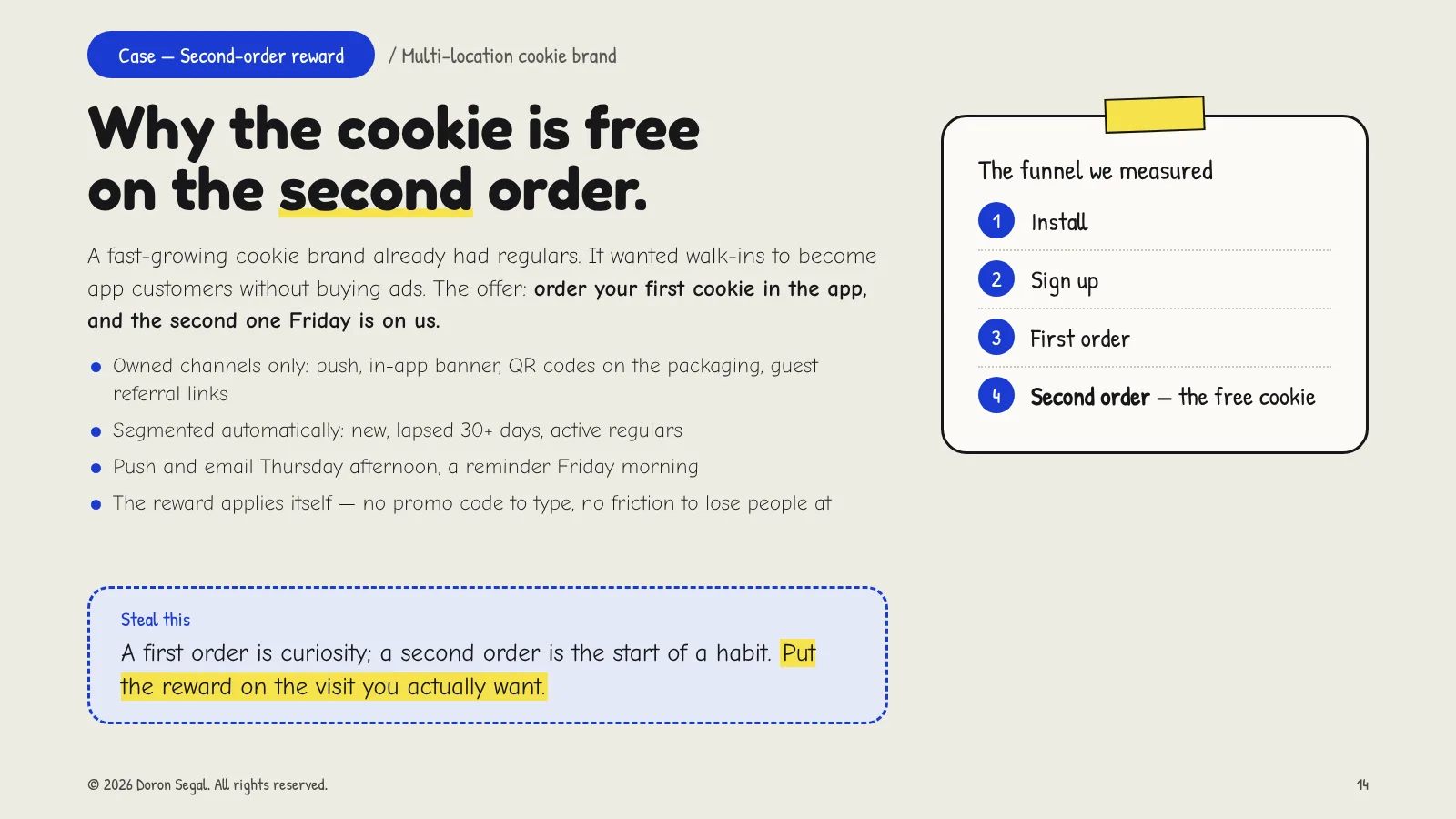
  14. Case: a multi-location cookie brand turned walk-ins into app customers without ads — first cookie in the app, second one on Friday free. Owned channels only (push, in-app banner, QR on packaging, referral links), automatic segments for new, lapsed and active guests, Thursday and Friday sends, and a reward that applies itself. The funnel: install, sign up, first order, second order. Steal this: put the reward on the visit you want. 14 Why the cookie is free on the second order
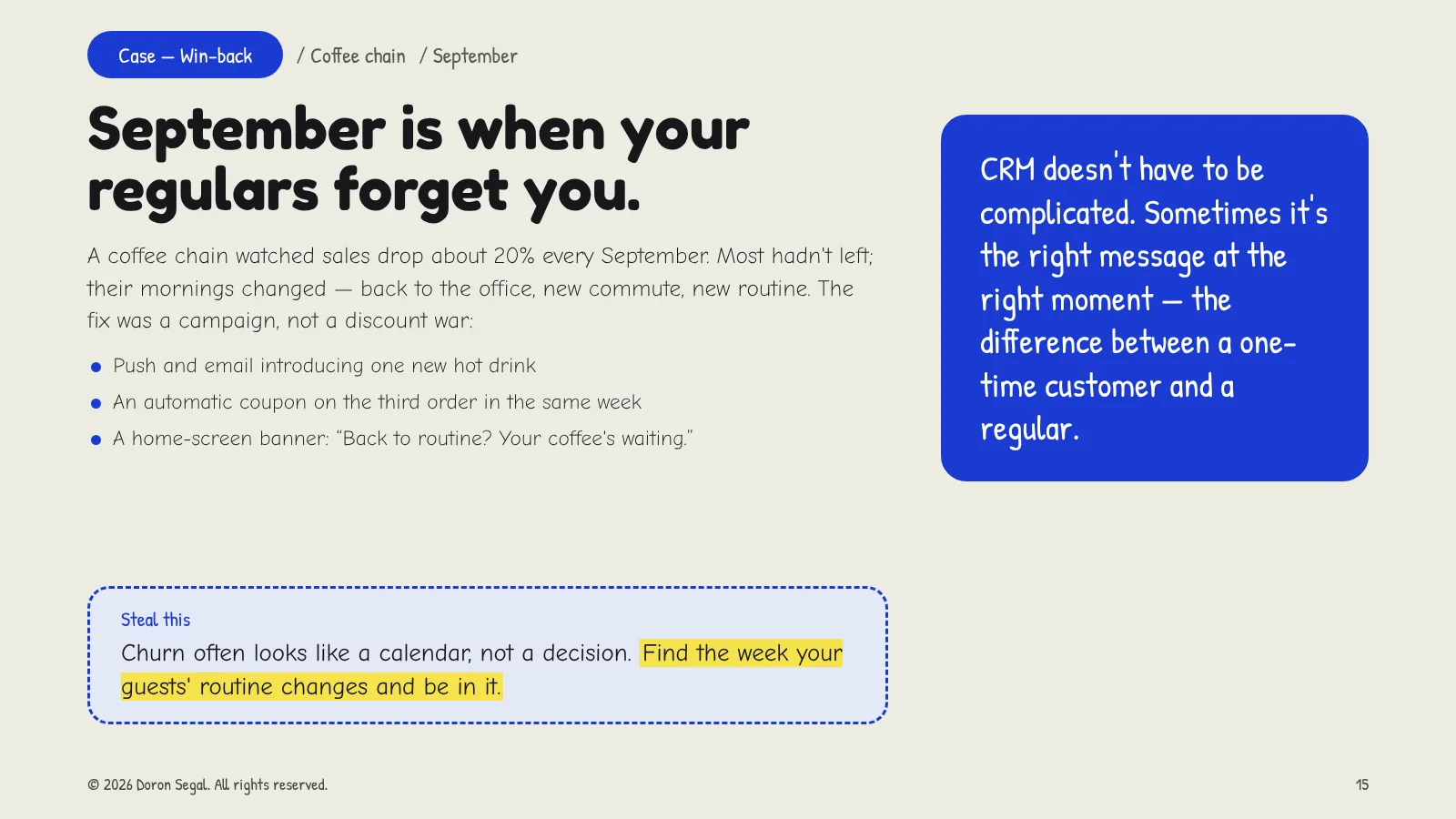
  15. Case: a coffee chain saw sales drop about 20% every September as routines changed. The campaign: push and email for one new hot drink, an automatic coupon on the third order that week, and a banner reading 'Back to routine? Your coffee's waiting.' Steal this: churn often follows the calendar — find the week routines change and be in it. 15 September is when your regulars forget you
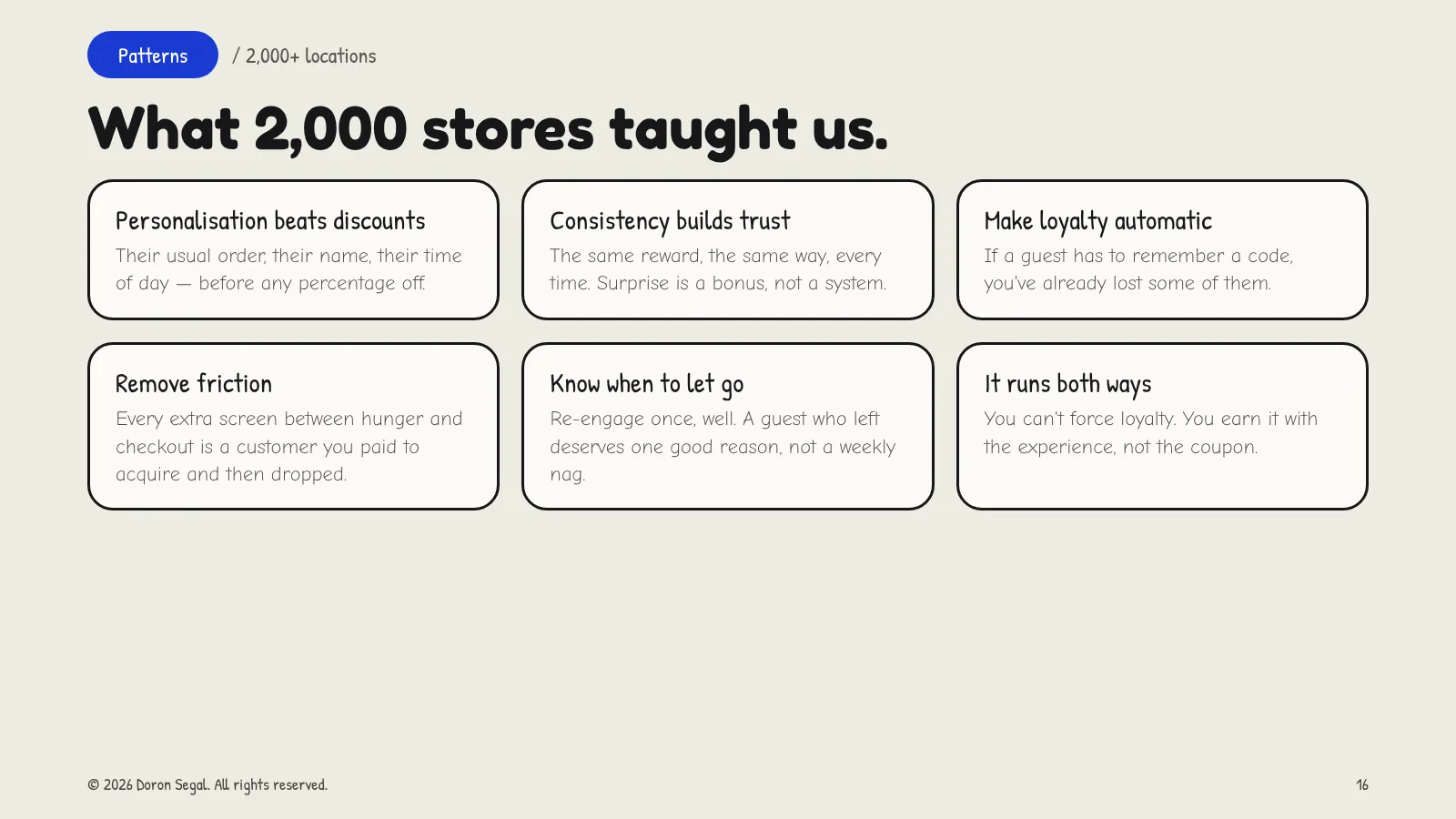
  16. Lessons from 2,000+ locations: personalisation beats discounts; consistency builds trust; make loyalty automatic; remove friction; know when to let go; and loyalty runs both ways — earned through experience, not coupons. 16 What 2,000 stores taught us
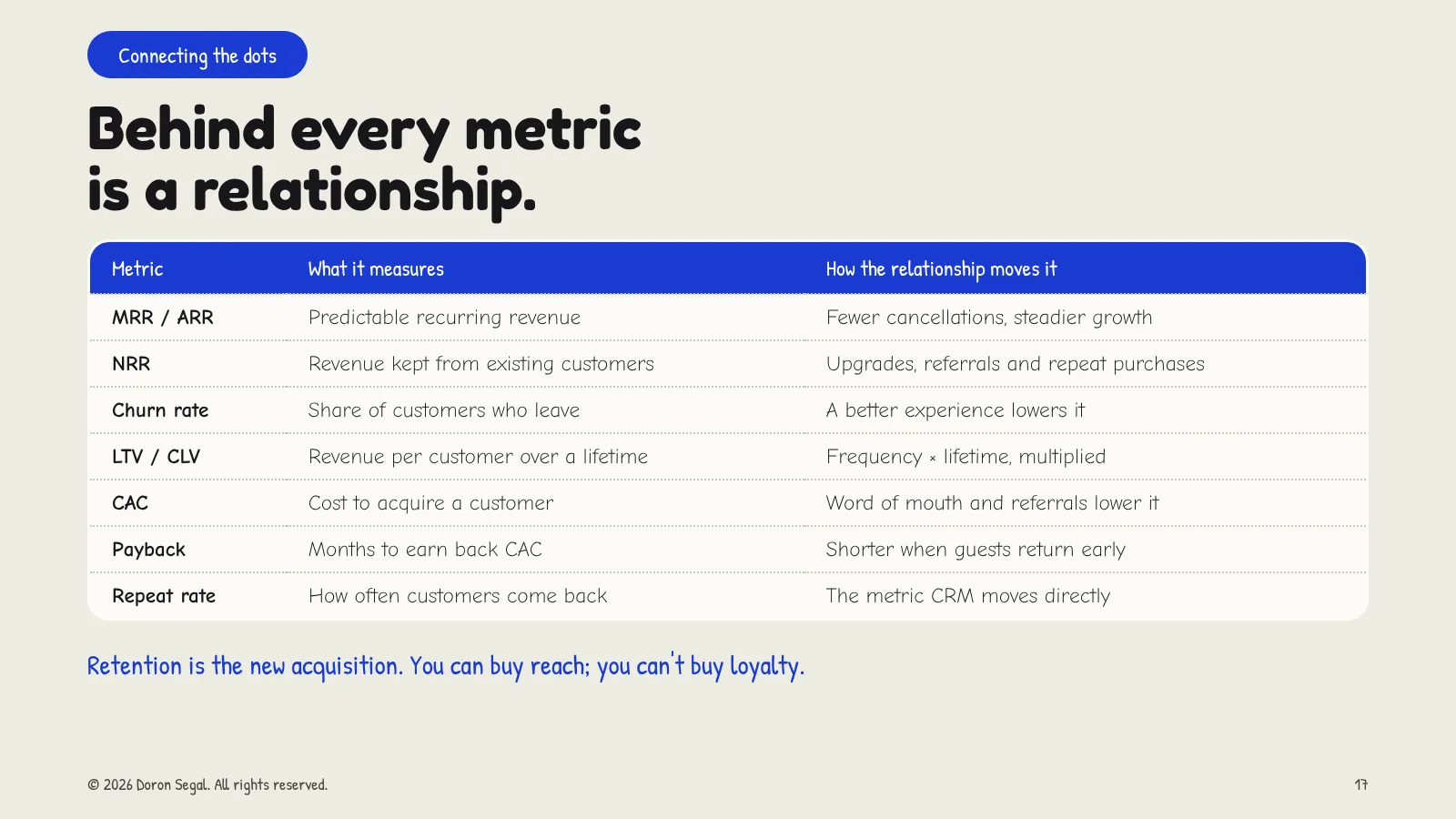
  17. Metrics table: MRR and ARR, NRR, churn rate, LTV/CLV, CAC, payback period and repeat purchase rate — what each measures and how strong customer relationships move it. Retention is the new acquisition: you can buy reach, but you can't buy loyalty. 17 Behind every metric is a relationship
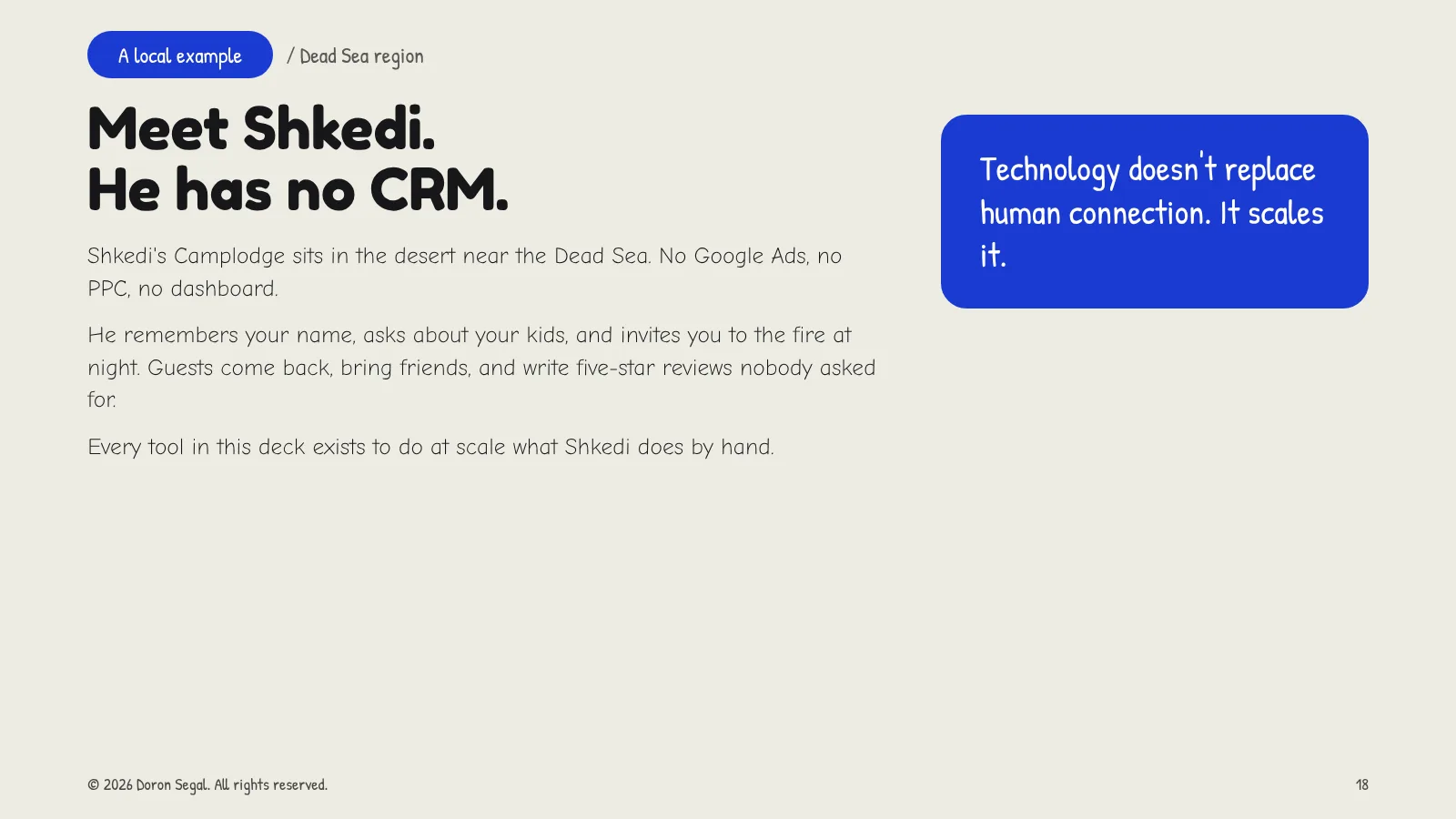
  18. A local example: Shkedi's Camplodge near the Dead Sea runs no ads and no CRM software, yet guests return, bring friends and leave unprompted five-star reviews because he remembers names and invites guests to the fire. The tools in this deck exist to do at scale what he does by hand. Technology doesn't replace human connection; it scales it. 18 Meet Shkedi. He has no CRM.
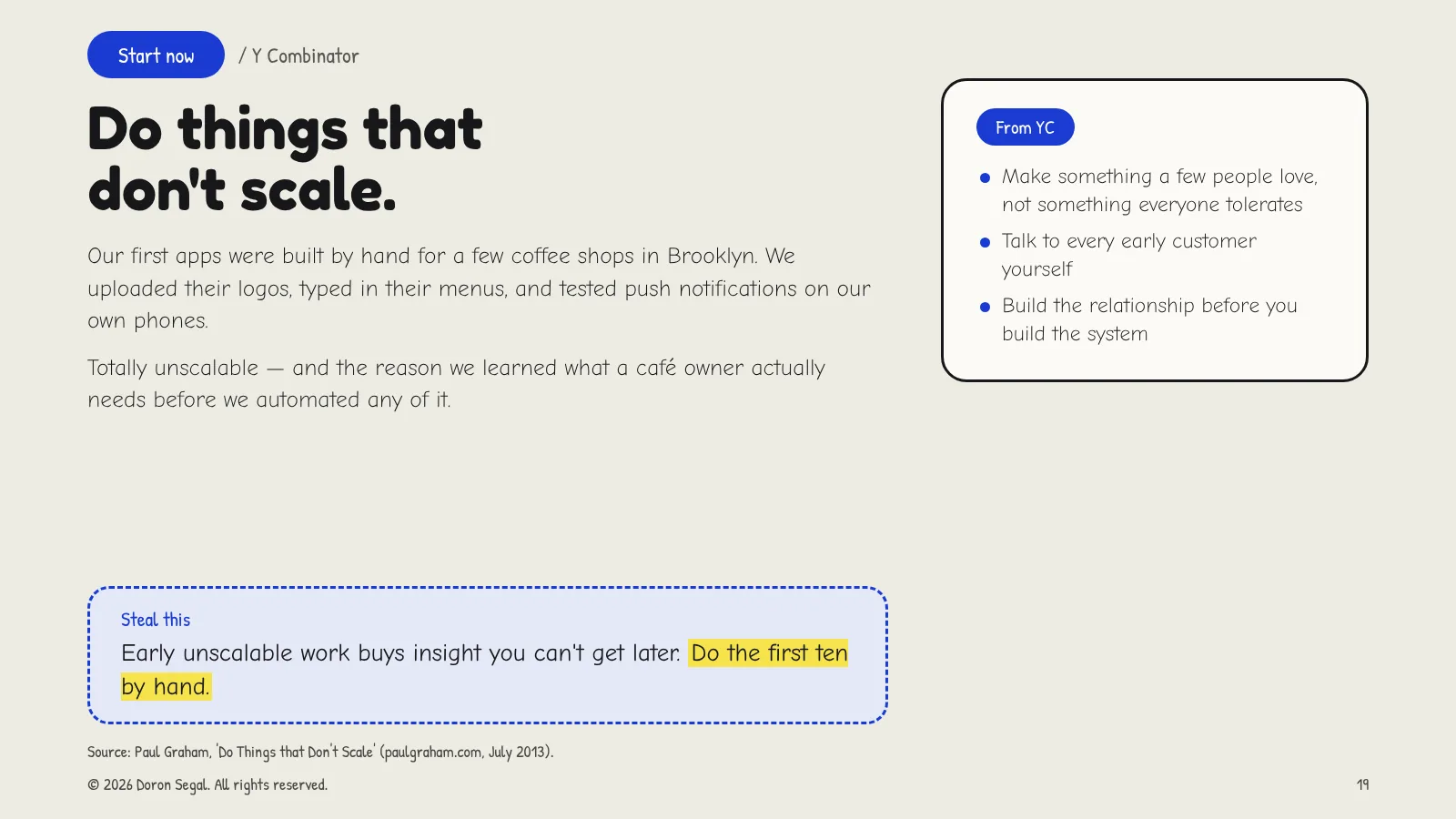
  19. Start now: Per Diem's first apps were built by hand for a few Brooklyn coffee shops — logos uploaded, menus typed in, push tested on the founders' phones. Following Paul Graham's 'Do Things that Don't Scale': make something a few people love, talk to every early customer, and build the relationship before the system. Steal this: do the first ten by hand. 19 Do things that don't scale
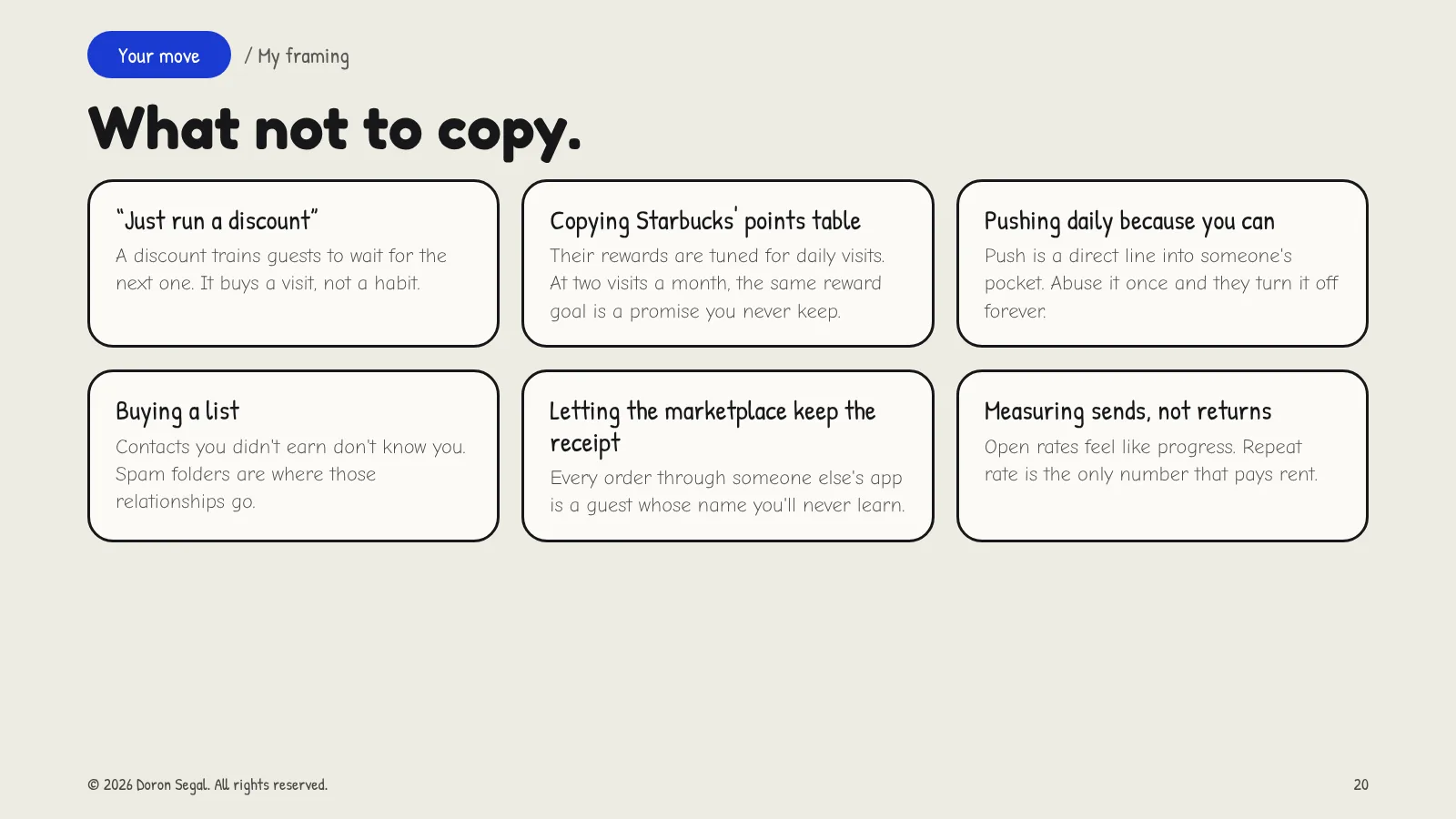
  20. What not to copy: running discounts that train guests to wait; copying Starbucks' points table without Starbucks' visit frequency; pushing daily because you can; buying contact lists; letting the marketplace keep the receipt; and measuring sends instead of returns. 20 What not to copy
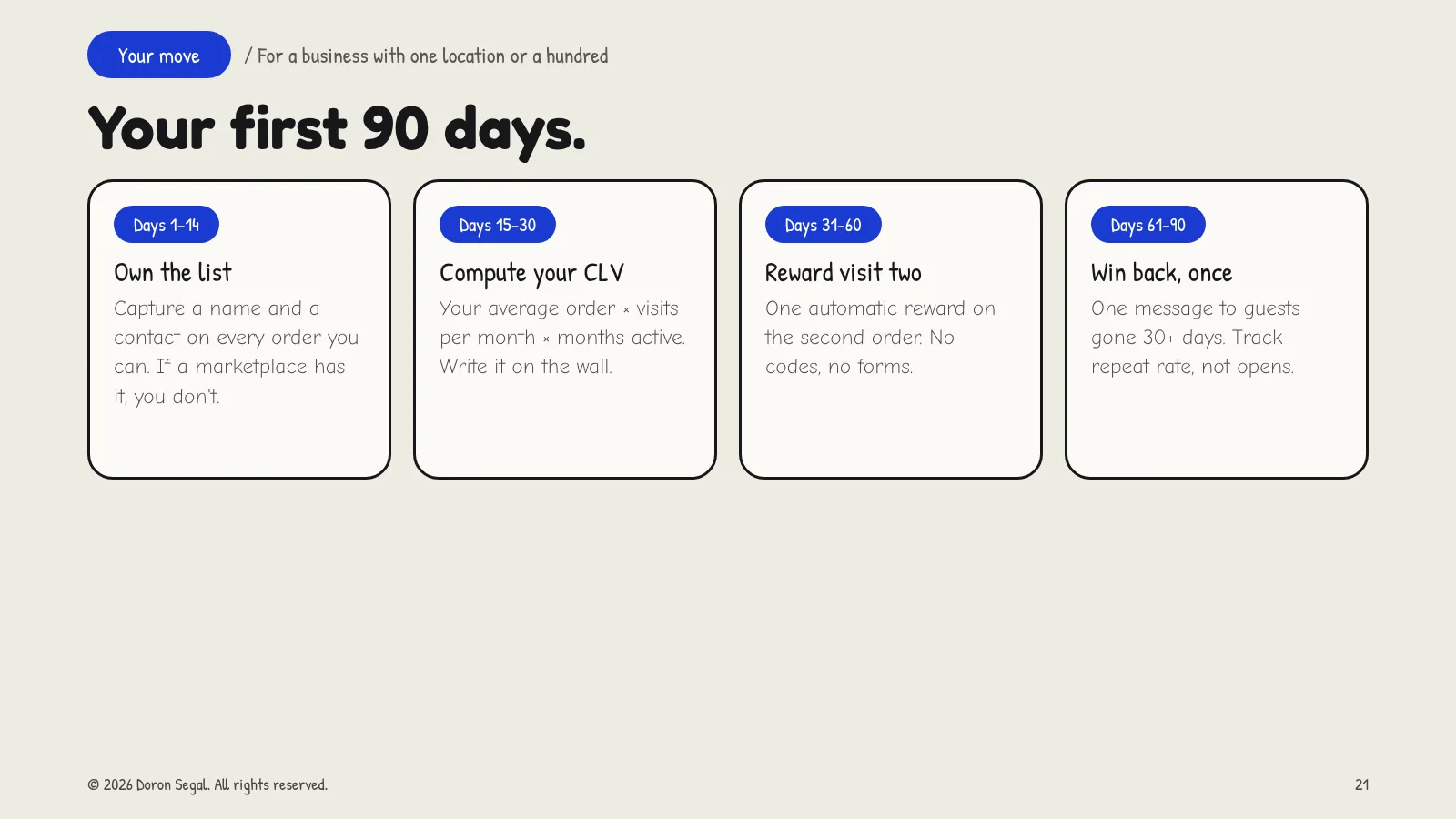
  21. Your first 90 days: days 1–14 own the list by capturing a contact on every order; days 15–30 compute CLV from your own numbers; days 31–60 add one automatic reward on the second order; days 61–90 send one win-back to guests gone 30+ days and track repeat rate, not opens. 21 Your first 90 days
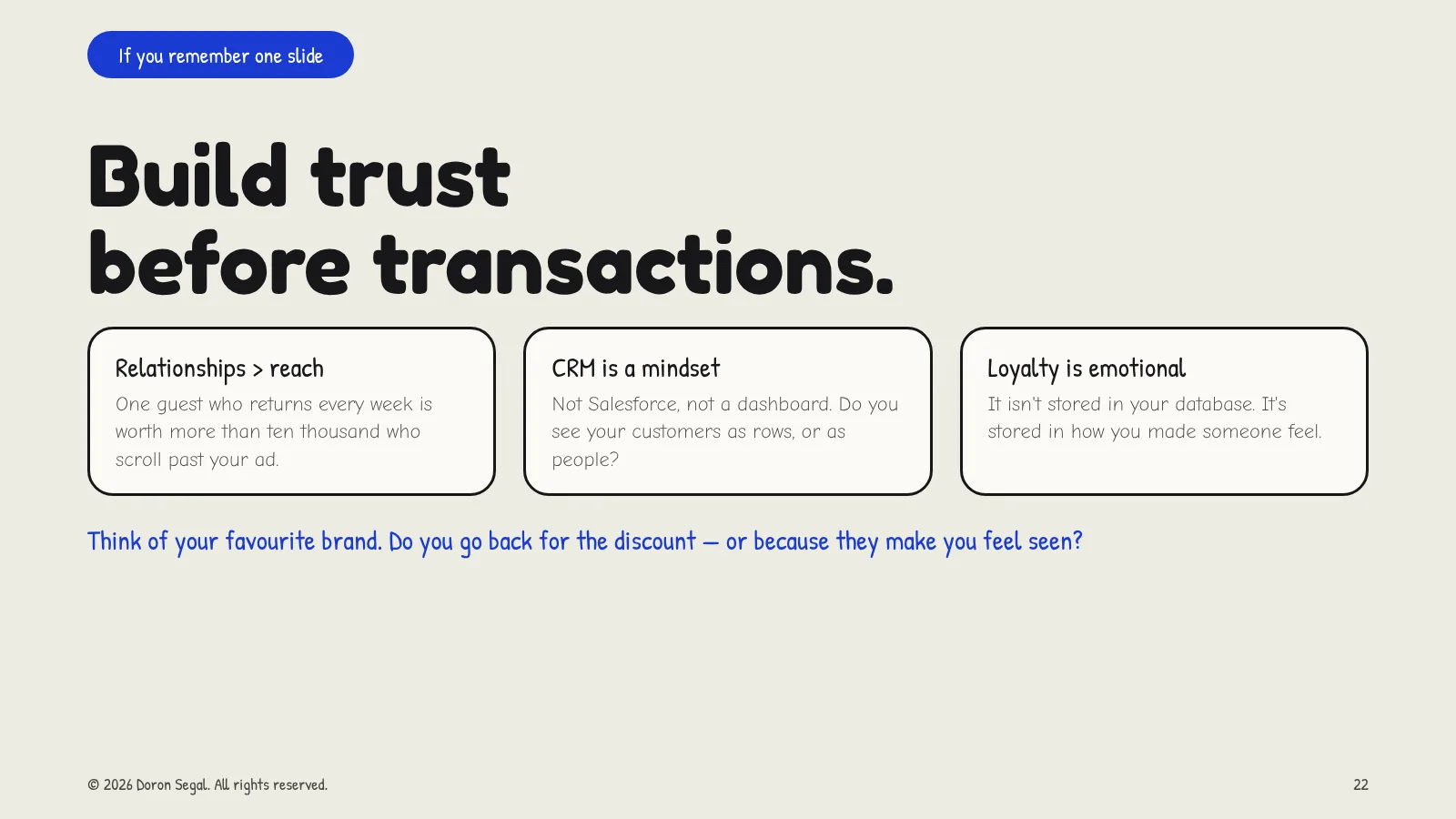
  22. Takeaway: build trust before transactions. Relationships beat reach; CRM is a mindset, not a tool; loyalty is emotional and stored in how you made someone feel. Question to the room: do you return to your favourite brand for the discount, or because they make you feel seen? 22 Build trust before transactions
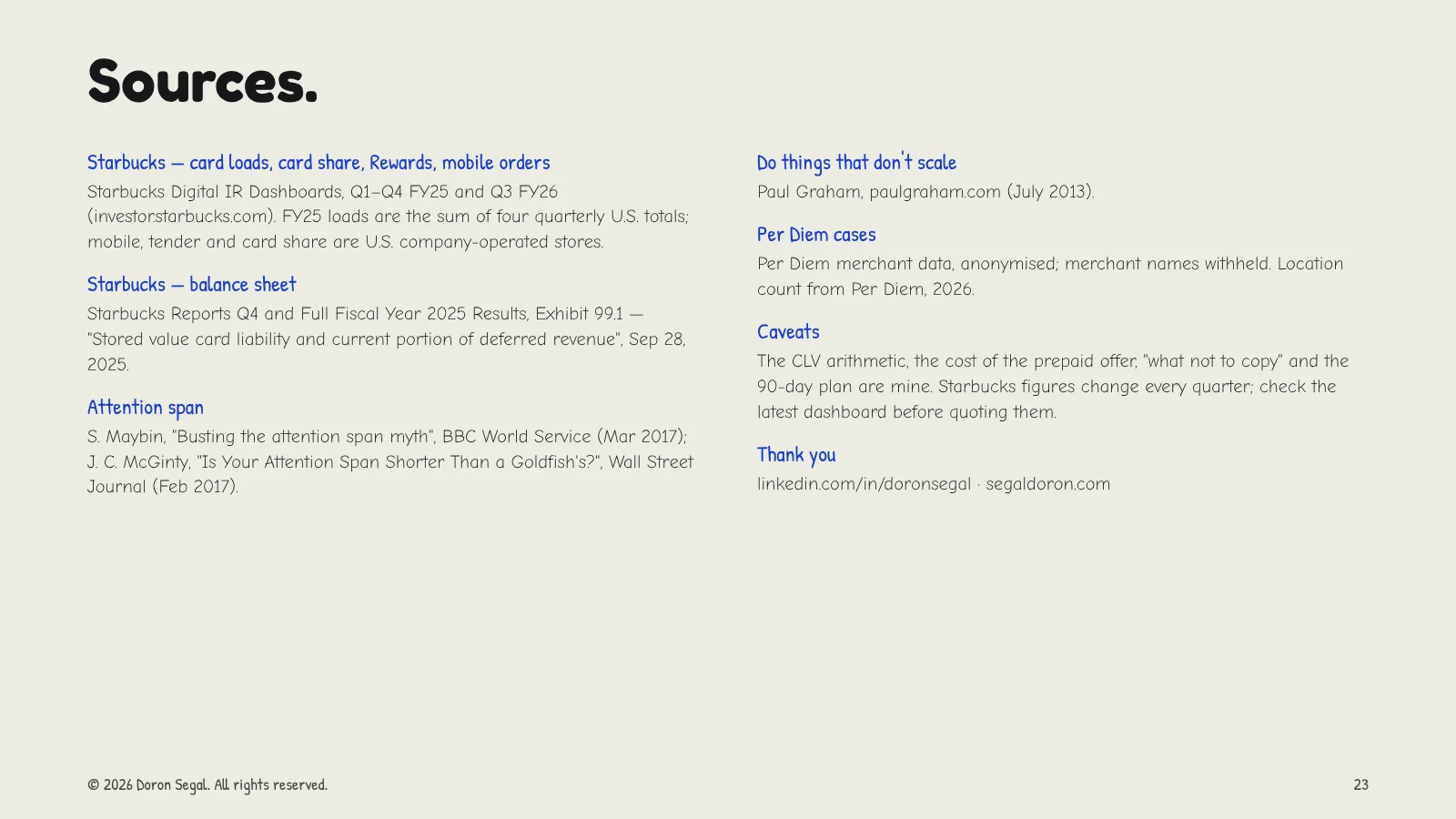
  23. Sources: Starbucks Digital IR Dashboards (Q1–Q4 FY25, Q3 FY26) and the Q4 FY25 earnings release; BBC World Service and Wall Street Journal (2017) on the attention-span myth; Paul Graham's 'Do Things that Don't Scale' (2013); Per Diem merchant data, anonymised. The CLV arithmetic, prepaid-offer cost, what-not-to-copy and 90-day plan are the author's own. 23 Sources

The short version

  • Starbucks is a bank that sells coffee. U.S. customers loaded $11.9B onto Starbucks cards in fiscal 2025, and the balance-sheet line holding unspent card money stood at $1.84B. Rewards members account for 59% of U.S. tender, and a third of U.S. orders are placed in the app.
  • Everyone else rents their customers. Order through a marketplace and the platform keeps the relationship; the kitchen that took the risk never learns your name.
  • The levers multiply. CLV is average order × orders per month × months active. A $6 latte weekly for a year is $288; twice as often and half again as long is $864 — three times the value from two modest changes.
  • A prepaid bonus is a discount. A New York café's pay-$25-get-$35 offer brought in $18,000 in a month and nearly quadrupled app orders — and cost a 28.6% discount on every dollar redeemed. Worth it when it changes behaviour, a price cut when it doesn't.
  • Reward the second visit. A first order is curiosity; a second is the start of a habit.

The 8-second attention span on slide three is the warning label for the rest of the deck: it came from a 2015 report that cited a website whose own sources had no record of it. Every outside number here has a name next to it on the last slide.

Want this delivered to your class or your team, or a second pair of eyes on your loyalty program? Book a call.